How Long After Leaving a Job Does Insurance Last?
Employer health insurance usually ends on your last day or at month end. Here is the dated timeline for COBRA elections, Marketplace enrollment and the first week after a layoff.
TL;DR: COBRA is the federal right to keep your old job's health plan after you leave. Employer health insurance itself usually ends on your last day of work or on the last day of that month, depending on your plan. After that, COBRA gives you at least 60 days to elect up to 18 months of the same coverage, and losing job-based coverage opens a 60-day Marketplace Special Enrollment Period. Pick a path in week one, not on day 59.
How long insurance lasts after leaving a job is set by your employer's plan document, not by federal law: most plans end coverage either on your final day of employment or at the end of the month you leave. The law takes over after that. COBRA continuation coverage is the federal right to keep your same group health plan for up to 18 months if your employer has 20 or more employees, at up to 102% of the full premium. The Marketplace at HealthCare.gov treats loss of job-based coverage as a qualifying event, giving you 60 days before or after the loss to pick a new plan. Medicaid accepts applications any time of year. This guide turns those rules into a dated timeline so you know exactly what is due and when.
What does "insurance lasts after leaving a job" actually mean?
Insurance lasting after leaving a job means the window between your final day of employment and the day your employer's group plan stops paying claims. That window is a plan design choice. There is no federal rule that says it must be 30 days or end of month.
Three common patterns show up in benefit plans:
- Ends on your last day. Coverage stops the same day your employment ends. A doctor's visit the next morning is not covered by that plan.
- Ends on the last day of the month. Leave on the 9th, stay covered through the 30th or 31st. This is common with plans that collect premiums monthly.
- Ends on a set date after separation. Some plans run coverage to a fixed date tied to the payroll calendar.
Severance agreements sometimes add employer-paid coverage or a COBRA subsidy for a few months. That is a negotiated benefit, so read the agreement line by line.
How to find your exact date: check the Summary Plan Description (SPD) your HR portal links to, look for "termination of coverage" or "when coverage ends," or ask HR to confirm the coverage end date in writing. Get the date in an email before your last day if you can.
Does health insurance end on your last day?
Health insurance ends on your last day only if your plan is written that way. Many plans keep you covered through the end of the month, so a person who leaves on November 3 might still be covered until November 30, while a person on a "last day" plan loses coverage on November 3.
The difference matters most for timing medical appointments and prescriptions. If you know your end date, you can refill a 90-day prescription or book a pending procedure before coverage stops.
Other benefits follow their own rules:
- Dental and vision usually end on the same schedule as medical, and are generally also eligible for COBRA if they are separate group plans.
- Group life insurance typically ends with employment, though many policies offer a conversion or portability option for a limited time.
- HSA money is yours to keep. The account moves with you, even though new contributions require HSA-eligible coverage.
- Health FSA balances often end with employment unless you elect COBRA for the FSA or the plan has a run-out period for claims.
How does COBRA work after you leave a job?
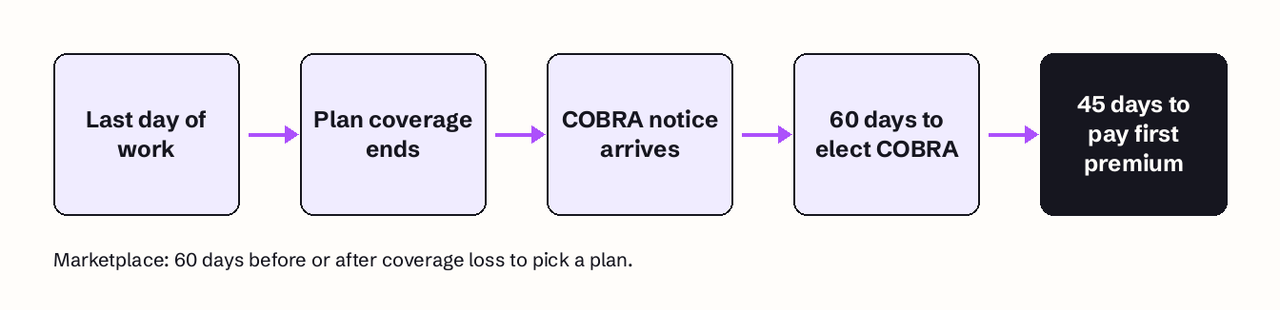
COBRA is a federal law that lets you continue your employer's group health plan after a qualifying event such as quitting, being laid off, or having your hours cut. It applies to group health plans of employers that normally employed 20 or more employees on a typical business day during the prior year, under 29 U.S.C. 1161. Many states have "mini-COBRA" laws for smaller employers, so check your state if your company is small.
The mechanics, from the statute and Department of Labor rules:
- Employer notice: your employer must notify the plan administrator within 30 days of your qualifying event (29 U.S.C. 1166).
- Election notice: the administrator then has 14 days to send you a COBRA election notice. If the employer is also the administrator, the combined deadline is 44 days.
- Election window: you get at least 60 days to elect, counted from the later of the date you lose coverage or the date the notice is sent (29 U.S.C. 1165).
- First payment: the plan cannot require your first premium earlier than 45 days after you elect (29 U.S.C. 1162).
- Ongoing payments: each later premium counts as on time if paid within 30 days of the due date. Miss that grace period and coverage can end for good.
- Duration: up to 18 months for termination or reduced hours. A Social Security disability determination during the first 60 days of COBRA can extend it to 29 months. A second qualifying event, such as divorce or the employee's death, can extend dependents to 36 months.
Coverage is elected retroactively to the day your plan coverage ended. That is the most useful detail in the whole law: if you have an emergency during the election window, you can still elect COBRA and the claim is covered, as long as you then pay the premiums.
COBRA does not cover workers fired for gross misconduct. The statute counts termination "other than by reason of such employee's gross misconduct" as a qualifying event, which means a misconduct firing is the one way to leave a job and lose the right outright.
An insurance broker walks through what COBRA is, who qualifies, and how the notice, election and payment steps work. It covers the 20-employee rule, the 60-day election window, retroactive coverage and the 18, 29 and 36 month limits.
How much does COBRA cost? A worked example
COBRA costs the full premium, both your share and the share your employer used to pay, plus up to a 2% administration fee. The statute caps the charge at 102% of the plan's applicable premium, or 150% during a disability extension.
A worked example with round numbers:
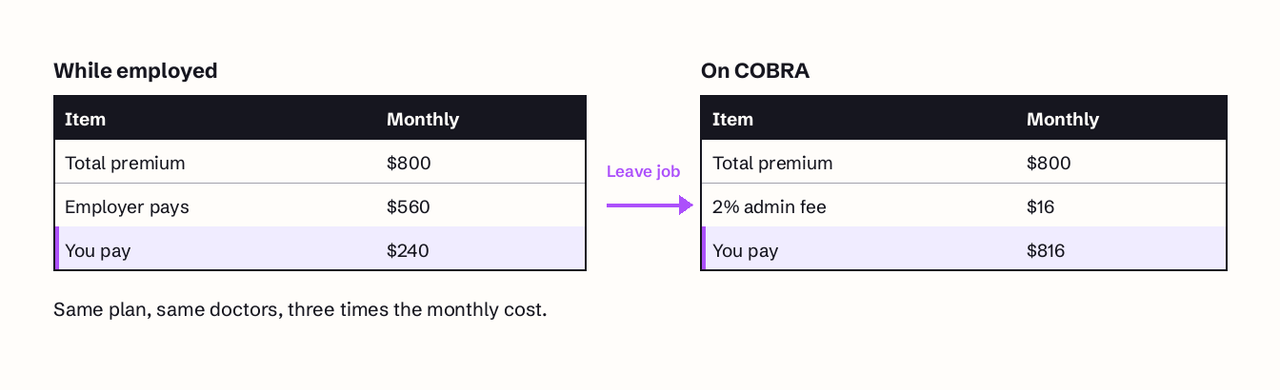
- Total monthly premium for employee-only coverage: $800
- Employer paid while you worked: $560 (70%)
- You paid through payroll: $240
- COBRA monthly cost: $800 x 1.02 = $816
So the bill jumps from $240 to $816 a month, more than three times what you saw on your pay stub. Over the full 18 months that is $14,688. Family coverage multiplies the problem, since the family premium is often two to three times the employee-only rate.
That is why COBRA is best used as a bridge or a safety net, not a default. It makes the most sense when you:
- are mid-treatment and need the same doctors and network,
- have already met most of this year's deductible and out-of-pocket maximum,
- expect a new job with benefits within a few months, or
- have income too high for meaningful Marketplace subsidies.
Can I get Marketplace coverage after losing a job?
Yes. Losing job-based health coverage qualifies you for a Special Enrollment Period on HealthCare.gov or your state's exchange. According to HealthCare.gov's Special Enrollment Period rules, you qualify if you lost qualifying coverage in the past 60 days or expect to lose it in the next 60 days.
That "next 60 days" clause is what most guides miss. If you know your last day in advance, you can apply before you leave and pick a plan that starts the day after your old coverage ends, with no gap at all.
Key rules for the Marketplace route:
- Income is estimated for the year. Premium tax credits are based on your expected household income for the calendar year. A layoff in the middle of the year can lower that estimate a lot.
- Documents may be required. HealthCare.gov asks for proof of coverage loss, such as a letter from your employer or insurer. If you cannot provide acceptable documents, you will not qualify.
- Picking COBRA does not lock you in forever. If you elect COBRA and it later runs out at 18 months, you get a new 60-day Special Enrollment Period.
- Dropping COBRA early is the trap. HealthCare.gov states that voluntarily dropping COBRA or choosing to stop paying premiums does not qualify you for a Special Enrollment Period. Outside open enrollment, that can leave you with nothing.
The practical move: compare a Marketplace quote against your COBRA notice inside the first 60 days, while both doors are open.
Is quitting different from being laid off for insurance?
For health insurance, quitting and being laid off are treated the same. COBRA counts any termination of employment as a qualifying event, voluntary or not, except a firing for gross misconduct. The Marketplace counts any loss of job-based coverage, regardless of why the job ended.
Where they differ:
- Severance: layoffs often come with severance, which may include paid COBRA months. Quitting rarely does.
- Timing control: when you quit, you choose your last day. Leaving on the 1st of a month on an end-of-month plan gives you almost a full month of coverage. Leaving on the 31st gives you one day.
- Unemployment benefits: quitting usually affects unemployment insurance eligibility, which can affect how you budget for premiums.
If you control your exit date, check the plan's end-of-coverage rule before you hand in notice. Our resignation letter generator and two weeks notice letter tool help with the paperwork once you have picked the date.
COBRA vs Marketplace vs other options
COBRA and Marketplace plans are the two most common bridges, but they are not the only ones. Here is how the options compare:
- COBRA: same plan and network; up to 18 months; full premium plus 2%; no income-based subsidy; elect within 60 days.
- Marketplace plan: new plan and possibly a new network; lasts as long as you pay; premium tax credits based on expected income; pick within 60 days before or after the loss.
- Medicaid or CHIP: low or no cost; based on current monthly income and state rules; apply any time of year.
- Spouse's or parent's plan: losing your coverage is generally a qualifying event for their employer plan too, usually with a 30-day enrollment window, though plans vary. Under 26, a parent's plan is an option.
- Short-term health plans: not ACA-compliant, can exclude pre-existing conditions and benefits like prescriptions or maternity care. Treat them as a last resort.
A week-one plan after a layoff or resignation
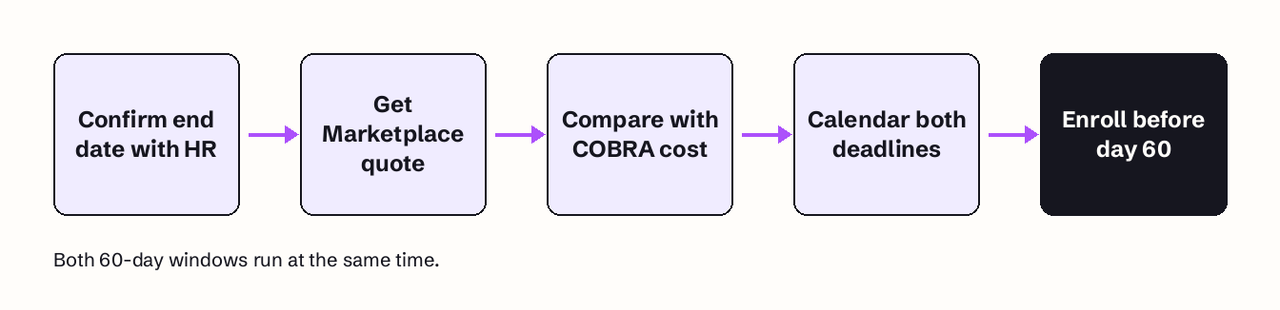
The 60-day windows are generous, which is exactly why people miss them. Here is a dated plan, assuming a last day of November 14:
- Before your last day: ask HR for the coverage end date in writing and the COBRA administrator's name. Refill prescriptions.
- Day 1 to 3: get a Marketplace quote at HealthCare.gov with your realistic income estimate for the year. Check Medicaid eligibility if income will be low.
- Day 3 to 7: compare that quote with the expected COBRA cost. Check a spouse's plan enrollment window, which may be only 30 days.
- When the COBRA notice arrives: put the election deadline and the 45-day first-payment date in your calendar.
- Before day 60: decide. Enroll in the Marketplace plan, elect COBRA, or both if you are using COBRA as a safety net while a Marketplace plan starts.
Once coverage is sorted, the next problem is the job search itself. Our 30-day job search plan after a layoff lays out the first month, and how to explain a layoff in an interview covers the conversation you will have in almost every interview. If you want to shorten the gap, JobFinder AI matches you with open roles and helps you reach hiring managers directly, so you spend your time on applications that can actually turn into an offer with benefits.
When offers do come in, compare the employee benefits in each job offer, including when health coverage starts. Some employers have a waiting period of up to 90 days, which can make COBRA worth keeping for a month or two.
Common mistakes that cause a coverage gap
- Assuming the end of the month. Plans that end on your last day leave no buffer.
- Waiting for the COBRA packet before thinking. The Marketplace window starts at coverage loss, not at the COBRA notice.
- Dropping COBRA to switch mid-year. Voluntary cancellation does not open a Marketplace Special Enrollment Period.
- Missing the 30-day grace period. One late premium can end COBRA permanently.
- Forgetting dependents. Your spouse and children have their own COBRA election rights and can elect independently.
FAQ
How long does health insurance last after you quit your job?
It depends on your plan. Most employer plans end coverage on your last day of work or on the last day of that month. After that, you can continue the same plan through COBRA for up to 18 months if your employer has 20 or more employees.
What should I do first after my last day?
Write down two dates: the day your plan coverage ends and the day 60 days after it. Get a Marketplace quote in the first few days so you can compare it with the COBRA notice when it arrives, instead of deciding under deadline pressure.
Can I get Marketplace coverage after losing a job?
Yes. Losing job-based coverage gives you a Special Enrollment Period on HealthCare.gov. You can apply up to 60 days before your coverage ends or up to 60 days after, and premium tax credits are based on your expected income for the year.
Is quitting different from being laid off for health insurance?
No, not for COBRA or the Marketplace. Both treat any job loss as a qualifying event, except a firing for gross misconduct, which removes COBRA rights. The differences are severance, which may pay for some COBRA months, and your control over the last-day date.
Does my employer have to offer COBRA if the company is small?
Federal COBRA applies only to employers that normally had 20 or more employees in the prior year. Many states have their own continuation laws, often called mini-COBRA, that cover smaller employers, so check your state insurance department.