Recruiter vs Hiring Manager: Who Screens, Who Decides
The recruiter runs the process and screens you; the hiring manager owns the role and decides. What each one tests, who to email at each stage, and who handles the offer.
TL;DR: The recruiter runs the hiring process: they screen applications, schedule interviews and relay the offer. The hiring manager is the person you would report to: they define the role, run the job-specific interviews and make the final decision. Ask the recruiter about process and pay; prove to the hiring manager you can do the work.
The difference between a recruiter and a hiring manager is ownership. A recruiter owns the process (sourcing, screening, scheduling, candidate communication and offer logistics) across many open roles at once. A hiring manager owns one role: they decided the team needs someone, they set what "good" looks like, and they have the final say on who gets the offer. Greenhouse, one of the most widely used applicant tracking systems, writes this split into its software: the recruiter "guides the overall hiring process and creates the structure for success", while the hiring manager "acts as the subject-matter expert (SME) for the role" (Greenhouse Support). For you as a candidate, that means two different conversations: use the recruiter to understand the process, and use the hiring manager to win the job.
Recruiter vs hiring manager: who does what
Most pages on this topic are written for HR teams splitting work. This table is from the candidate's side: who you are talking to and what to say.
| Criterion | Recruiter | Hiring manager |
|---|---|---|
| Who they are | Recruiting or HR specialist, in-house or at an agency | The person you would report to, often a team lead, director or founder |
| What they own | The process across many roles | One role and the final decision |
| When you meet them | First: resume screen and a 15 to 30 minute phone screen | Middle and late rounds: role interview, take-home, final |
| What they test | Basic fit, must-haves, salary range, availability, communication | Whether you can do this specific work on this team |
| Who pays them | The employer (an agency is paid by the employer per placement) | The employer, as part of their normal job |
| What to ask them | Timeline, number of rounds, pay range, next interviewer | Priorities for the first 90 days, team gaps, success measures |
| When to email them | After applying, after the screen, when the process stalls, about the offer | Before applying or right after, and a thank-you after their round |
| Can they say yes | Usually no, they can say no at the screen | Yes, within budget and approval limits |
The recruiter: process owner and gatekeeper
A recruiter is the person responsible for filling open roles by finding, screening and moving candidates through the hiring process. The US Bureau of Labor Statistics describes recruitment specialists as people who "find, screen, and interview applicants for job openings", and puts median pay for human resources specialists, the group that includes recruiters, at $75,940 in May 2025 (BLS Occupational Outlook Handbook).
In Greenhouse, a recruiter assigned to a job is automatically given these tasks for every application: application review, advancing or rejecting candidates, sending scorecard reminders to interviewers, and managing alerts. Recruiters also typically build the scorecard, design the interview process and draft the questions. So when you are rejected in the first week without speaking to anyone, it was most likely a recruiter (or a rule they set up) who made that call.
There are two kinds you will meet:
- In-house (internal) recruiters are employees of the company, usually titled Recruiter, Talent Acquisition Partner or Technical Recruiter. They handle many roles at once.
- Agency recruiters work for an outside firm the company pays. According to SHRM, contingency recruiters typically earn 20% to 25% of the role's first-year cash compensation, and only if they fill the job; retained executive search firms charge about 33% (SHRM).
The hiring manager: owner of the role and the offer
A hiring manager is the person who requested the role, will manage whoever is hired, and makes the final hiring decision. Greenhouse describes them as the subject-matter expert who creates "the technical and/or job-specific pieces of the interview", such as the take-home exercise, the code review or finance-specific behavioral questions (Greenhouse Support). Many companies also add a "Hiring Manager Review" stage where the manager personally reviews the applications the recruiter passed along.
Their title will almost never say "hiring manager". For a Senior Data Analyst opening, the hiring manager is probably the Analytics Manager or Head of Data; at a 20-person startup it may be a founder. A simple rule: the hiring manager is whoever you would report to. Our guide on how to find a hiring manager's email address covers how to identify them from a job post and LinkedIn.
Who owns each stage of the hiring process?
The recruiter owns the top of the funnel and the logistics; the hiring manager owns the judgment calls. Debriefs and offers are shared. Here is a typical mid-size company process, stage by stage.
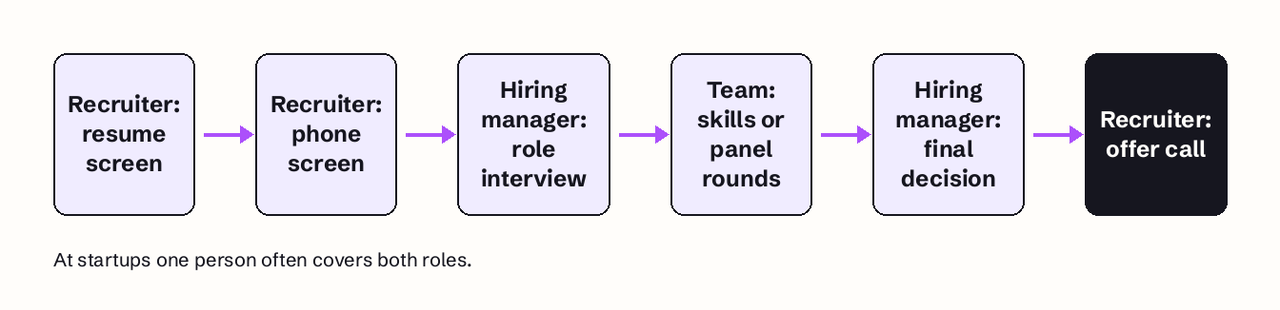
- Application review. The recruiter reviews applications against the must-haves. At some companies the hiring manager also reviews a shortlist in a dedicated review stage.
- Recruiter phone screen. Usually 15 to 30 minutes on background, motivation, location or work authorization, availability and salary expectations. See how to prepare for a phone interview.
- Hiring manager interview. The first conversation about the actual work: what you have done that matches their problems.
- Skills and team rounds. Technical tests, case studies, presentations or panel interviews, designed largely by the hiring manager and run by the team.
- Debrief and decision. Interviewers submit scorecards; the recruiter collects them and the hiring manager decides, sometimes with a skip-level or HR approval.
- Offer. The recruiter usually calls with the offer and negotiates the details, within limits the hiring manager and compensation team set.
Timing varies a lot. Ashby's 2026 benchmarks, based on 54 million applications across 93,000 jobs, put the median time to fill at 52 days for junior roles, 63 for mid-level and 71 for senior roles, and 75 days for technical roles (Ashby Talent Trends Report). If a recruiter says "two to three weeks" for the interview loop, that matches Ashby's median of 14.4 days (business roles) to 17.9 days (technical roles) from first to final interview.
A former recruiter explains that the recruiter is the first person in your job search but not the decision maker, why hiring managers never carry that title, and how a referral to the hiring manager can skip the recruiter screen entirely.
Phone screen vs role interview: how to prepare for each
A recruiter interview checks whether you clear the basic bar and fit the logistics; a hiring manager interview checks whether you can do this job better than the other finalists. Prepare for them differently.
Recruiter interview. Expect "walk me through your background", "why are you looking", "what are your salary expectations", "when could you start" and "are you interviewing elsewhere". The recruiter usually is not an expert in your field, so speak in plain language, mirror the job post's key requirements, and keep each answer under two minutes. The goal is to get passed along with a clean note. Our guide on how to answer salary expectations in an interview covers the money question.
Hiring manager interview. Expect depth: "tell me about a time you...", "how would you approach our X problem", "what would you do in your first 90 days". They know the work, so vague answers fall flat. Bring two or three stories with numbers that map to the job's top requirements, and ask questions that show you understand their priorities: "What is the most important thing this person needs to fix in the first quarter?" or "What did the last person in this role struggle with?"
Who should you email, and when?
Email the hiring manager when you want to be considered for the work, and email the recruiter when you need something from the process. In practice that means different people at different stages.
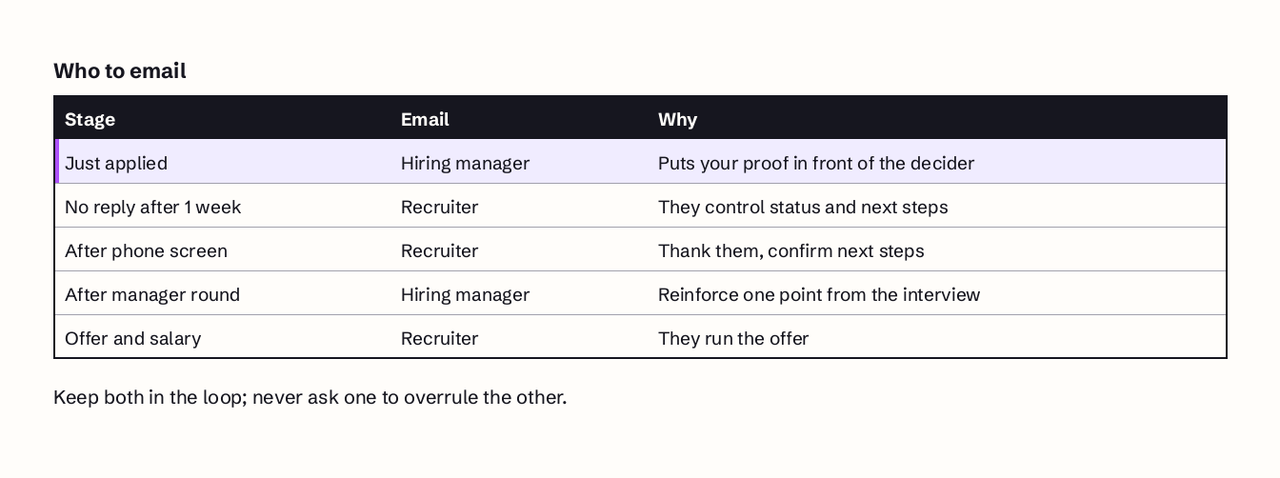
Ashby's data supports reaching people, not just portals: referred candidates pass the screen 52% of the time, compared with 35% overall. A short, specific note to the hiring manager is not a referral, but it puts your name in front of the person who can ask the recruiter to look again.
Example: email to the hiring manager right after applying
Subject: Senior Data Analyst application: churn model at Brightline
Hi Priya, I just applied for the Senior Data Analyst role on your team. The post mentions reducing churn in the mid-market segment. At Brightline I built the churn model our CS team used to prioritize 400 accounts, and renewals in that segment rose from 81% to 88% over two quarters. Happy to walk you through how it worked if useful. Thanks, Sam
Example: email to the recruiter when the process stalls
Subject: Senior Data Analyst: checking on next steps
Hi Jordan, thanks again for the screen on May 12. I am still very interested in the role and wanted to check whether there is an update on next steps or timing. I am happy to send anything that would help. Best, Sam
Keep the hiring manager email under 120 words, lead with one proof point that matches the job post, and do not attach your resume a second time. For timing and follow-ups, see how to email a hiring manager after applying and how to email a recruiter after applying.
If you are applying to many roles, finding the right hiring manager and writing a specific note for each one is the slow part. JobFinder AI applies to matched jobs, then finds a verified hiring manager email and sends a short note from your own inbox, with follow-ups. You can start a hunt here, or do the same by hand with the templates above.
Who makes the final hiring decision?
The hiring manager makes the final decision in most companies, within a budget and approval chain set by others. Workable, an applicant tracking system vendor, puts it plainly: "hiring managers are the decision-makers; they have the final say as to who gets hired and who gets rejected" (Workable). Exceptions you should know about:
- Hiring committees (common at large tech companies) make the call from written interview feedback, and the hiring manager is one voice among several.
- Skip-level or executive approval is common for senior roles or anything above the approved salary band.
- Agency recruiters never decide. They present candidates; the client company decides.
- Small startups often merge both roles: the founder screens, interviews and decides.
The recruiter cannot hire you, but they can reject you at the screen, and their write-up shapes how the hiring manager reads your file.
Is a recruiter on your side during salary negotiation?
Partly. An in-house recruiter is paid by the employer and works for it, but they also want you to accept: an accepted offer closes their requisition. Ashby reports median offer acceptance of 89% for business roles and 84% for technical roles, and recruiters are often measured on numbers like these. That makes them a useful messenger for a reasonable counter, not an advocate who will fight the company for you.
An agency recruiter's fee is a percentage of your first-year pay, but they care more about the deal closing than about a few thousand dollars, so expect them to push both sides toward agreement.
Use this to your advantage:
- Ask the recruiter for the range early. In California, employers with 15 or more employees must put the pay scale in job postings, and any employer must give an applicant the pay scale on reasonable request (California Labor Code 432.3). Colorado, New York, Washington and several other states have similar posting rules.
- Negotiate through the recruiter, with reasons the hiring manager will support. "The scope includes managing two analysts, which matches roles paying X" travels well up the chain.
Our guide on how to negotiate salary after a job offer has scripts for the call.
Which person to contact first
Go to the recruiter first if:
- The company is large (500+ employees) and has a visible talent acquisition team.
- You need logistics answered: visa sponsorship, location, the pay range.
- You have already applied and heard nothing for more than a week.
Go to the hiring manager first if:
- The company is small or a startup with no dedicated recruiter.
- You have one proof point that maps directly to a problem in the job post.
- The role is specialized enough that a generalist screen might miss your fit.
Usually, do both: apply through the official channel so you exist in the ATS, then send the hiring manager a short note.
Common mistakes candidates make
- Pitching technical depth to the recruiter. They check must-haves and clarity, not your architecture choices.
- Asking the hiring manager about benefits in round one. Save logistics for the recruiter.
- Waiting forever. Ashby's median time to archive a candidate who was never interviewed is six days; after two weeks of silence, a short follow-up costs nothing.
- Going quiet with the recruiter after a strong manager round. The recruiter still schedules the next step and runs the offer.
FAQ
What is the difference between a recruiter and a hiring manager?
A recruiter manages the hiring process across many roles: sourcing, screening, scheduling and offers. A hiring manager owns one specific role, will manage the person hired, runs the job-specific interviews and makes the final decision. The recruiter decides who gets considered; the hiring manager decides who gets hired.
Should I email the recruiter or the hiring manager after applying?
Email the hiring manager right after applying with one proof point that matches the job, because they decide. Email the recruiter about status, timing and logistics, especially if a week passes without a reply or after a phone screen.
Phone screen vs role interview: how to prepare for each
A recruiter interview is a short screen on background, motivation, availability and salary expectations, run by someone who is usually not an expert in your field. A hiring manager interview goes deep on whether you can do the work: specific past examples, how you would tackle their problems and what you would do in your first months.
Who makes the final hiring decision?
In most companies the hiring manager makes the final decision, sometimes with sign-off from their own manager, HR or a hiring committee. Recruiters, including agency recruiters, do not make the final decision, although they can reject candidates at the screening stage.
Is a recruiter on my side during salary negotiation?
Only partly. An in-house recruiter works for the employer but wants you to accept the offer, so they will carry a reasonable, well-justified counteroffer to the hiring manager. An agency recruiter is paid a percentage of your first-year salary by the employer and mainly wants the deal to close. Be polite and specific, and negotiate through them.
Can the hiring manager and the recruiter be the same person?
Yes. At small companies and early-stage startups there is often no recruiter, so the founder or team lead posts the job, screens applications, interviews and decides. In that case, write every message for the decision-maker.