Sample Cover Letter for Data Entry Clerk: 7 Examples
Seven sample cover letters for data entry clerk jobs that prove typing speed, audited accuracy and software skills, from first job to medical, AP, remote and email.
TL;DR: A data entry clerk cover letter is a one-page letter, about 200 to 350 words, that proves three things with numbers: how fast you enter data, how accurate you are, and which software you use. Below are seven sample cover letters for a data entry clerk: experienced, no experience, medical, accounts payable, remote, career changer and a short email version. Jobfinder AI finds data entry and administrative roles that fit your CV and emails a verified hiring contact for you, so your letter reaches a person.
Try Jobfinder AI on your own search: upload your CV, review your first matches and approve your first batch of outreach before anything is sent.
The best sample cover letter for a data entry clerk reads like a quality report. The opening sentence names the job and your speed and accuracy, measured. One paragraph proves volume and accuracy: what records you entered (invoices, patient forms, orders), how many a day, your error rate and how you checked your work. One paragraph proves tools: Excel, an accounting system, a CRM or an electronic health record. The closing names the employer and asks for an interview or a skills test. MIT's career office gives the standard frame: one page, 10 to 12 point font, an introduction, two or three body paragraphs and a closing (MIT CAPD).
What should a data entry clerk cover letter include?
A data entry clerk cover letter should include five parts, in this order.
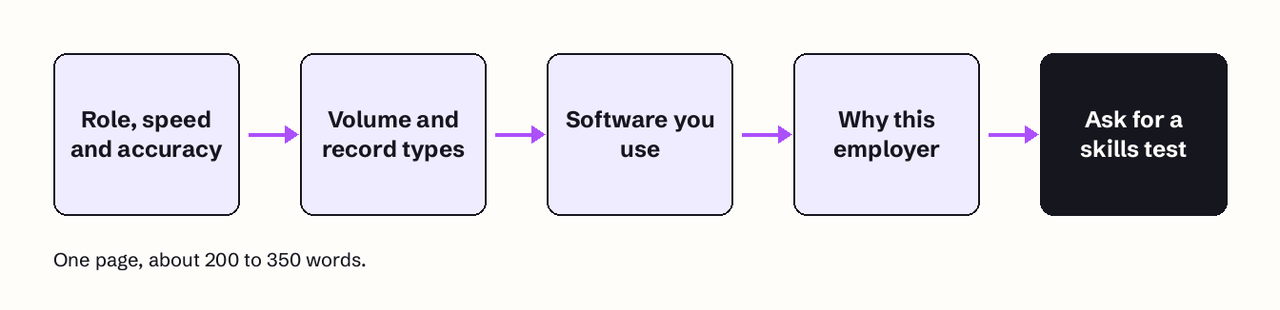
- Opening: the job title, the posting reference, and your tested typing speed plus accuracy.
- Volume and accuracy: the type of records, records per day or week, and how you catch errors (double entry, spot checks, reconciliation).
- Software: the exact programs (Excel 365, QuickBooks Online, Epic, Salesforce) in the posting that you have used, such as Excel, Access, QuickBooks or Sage 50.
- Fit: one specific line about the employer: their industry, their records, their hours.
- Close: ask for an interview and offer to take their typing or data entry test.
These match what the job is. ONET, the US Department of Labor's occupation database, lists the core tasks of data entry keyers as reading source documents such as canceled checks, sales reports or bills and entering the data in specific fields; locating and correcting errors or reporting them to supervisors; and comparing data with source documents, or re-entering data in verification format, to detect errors ([ONET](https://www.onetonline.org/link/summary/43-9021.00)). Your letter should prove each of those.
Why does accuracy matter more than speed now?
Accuracy matters more than speed because the work that remains is the work machines get wrong. O*NET counts 131,800 data entry keyers with a median wage of $19.88 an hour ($41,340 a year), and projects the occupation to decline by 1% or more from 2025 to 2035, with about 7,700 openings over the period. The Bureau of Labor Statistics projects a 2% decline for the wider group of information clerks over the same years (BLS). Scanning and automated capture handle clean, typed forms. What employers still hire people for is messy input (handwriting, mixed formats, exceptions) and checking. So lead with error rate and verification, then speed.
| What to prove | How to say it | Avoid |
|---|---|---|
| Speed | "65 WPM on a timed 5-minute test" | "fast typist" |
| Ten-key speed | "11,000 keystrokes per hour on 10-key" | "good with numbers" |
| Accuracy | "99.6% accuracy across 1,200 invoices a month" | "detail-oriented" |
| Verification | "double-entry check on every payment batch" | "careful" |
| Software | "Excel (VLOOKUP, filters), QuickBooks Online" | "computer literate" |
| Confidentiality | "handled patient records under HIPAA training" | "trustworthy" |
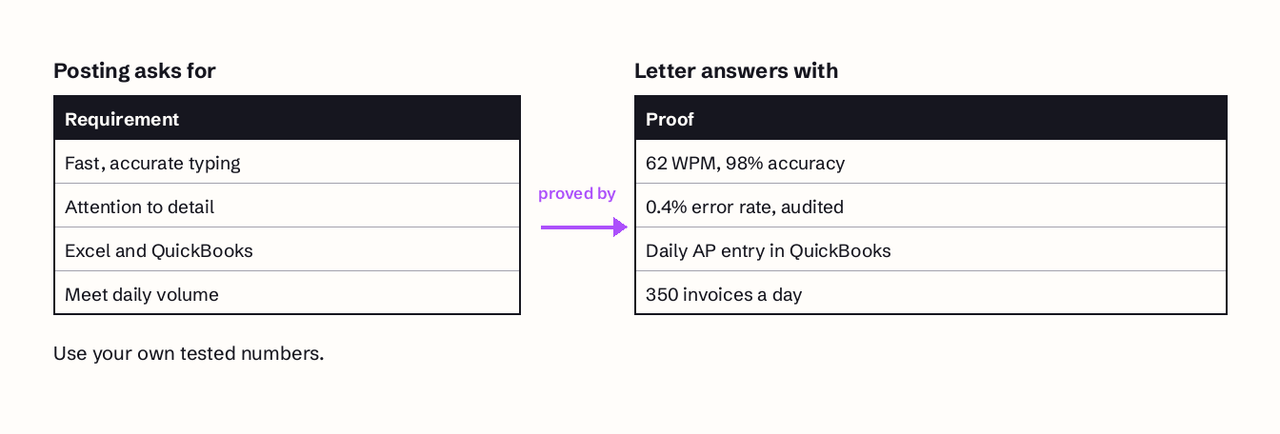
Typical records to name: W-2 and 1099 tax forms, CMS-1500 claim forms, purchase orders, bills of lading, timesheets and customer intake forms. Only quote a speed you can repeat. Many employers give a typing or 10-key test before an interview, so take a timed test online before you write the letter and use that number.
What Jobfinder AI does for data entry job applications
Jobfinder AI is an AI job search agent. It reads openings from employer career sites that run on Greenhouse, Lever, Ashby, Workday and SmartRecruiters, ranks them against your CV, and fills supported employer application forms. It submits a form only when every required answer can be given truthfully from your profile. Then it emails a verified hiring contact at the employer from your own inbox, and you approve the first batch of outreach before anything is sent.
For data entry work, that covers clerk, records, billing and operations support roles at hospitals, insurers, logistics companies and software firms that use those systems. The limit: many data entry jobs are posted by staffing agencies and small offices on job boards or their own sites, and Jobfinder AI will not see all of them. It also does not invent experience: your speed, accuracy and software must be real.
Names, companies and numbers in the samples below are invented. Replace them with your own.
1. Insurance claims clerk, three years in the job
Use it when: you have done data entry as a job and can quote volume and accuracy.
Dear Ms. Howard,
I am applying for the Data Entry Clerk position at Brightway Insurance (req 3318). For three years at Summit Claims I have entered claim forms at 250 to 300 per day at 98.8% accuracy by our monthly audit, and I type 68 WPM on a timed test.
I check every batch against the source documents before I close it, and I flag unreadable or incomplete forms to my supervisor the same day instead of guessing.
I work daily in Excel and in our claims system, and I have trained two new clerks on our entry standards.
I would be glad to take your data entry test and to talk about the role.
Best regards,
Maria Lopez
Why it works: volume, audited accuracy, a verification habit and a tested speed in the first lines.
2. First job, using food bank and register records
Use it when: this is your first data entry job.
Dear Hiring Manager,
I am applying for the Data Entry Clerk role at Greenfield Logistics. I type 60 WPM with 97% accuracy on a timed test, and I am comfortable in Excel and Google Sheets.
As a volunteer at the Eastside Food Bank I entered about 400 donation and client intake records a month into a shared spreadsheet, and I cleaned up a list of 1,100 duplicate contacts with filters and sorting.
In my retail job I count and reconcile the register at closing every shift, so checking numbers against a source is already a habit.
I am available for any shift and happy to take a typing test. Thank you for your time.
Sincerely,
Tyler Brooks
Why it works: volunteer and retail tasks become measured data work. See our guide to cold emails with a thin resume.
3. Medical data entry
Use it when: the role is at a clinic, hospital, lab or medical billing office.
Dear Ms. Carter,
I am applying for the Medical Data Entry Clerk role at Riverside Health. At Lakeview Family Practice I enter about 120 patient intake forms per day, with insurance details, into our electronic health record, and I completed HIPAA privacy training this year.
I verify every insurance ID against the card image before saving, which cut our claim rejections for ID errors, as reported by our billing team, from about 30 a month to 8.
I would welcome the chance to bring the same care to Riverside's records. Could we schedule a conversation?
Kind regards,
Aisha Grant
Why it works: medical employers worry about privacy and costly errors, and the letter addresses both.
4. Accounts payable or finance data entry
Use it when: you would enter invoices, payments or expense data.
Dear Mr. Nguyen,
I am applying for the Data Entry Clerk, Accounts Payable role at Harbor Supply. At Westline Distribution I enter vendor invoices at 300 to 350 per day into QuickBooks Online, match them to purchase orders and flag mismatches before payment.
Our controller's quarterly review found a 0.4% error rate on my entries, the lowest on the team. I also run a 10-key at about 11,000 keystrokes per hour.
Harbor's growth means more invoices, and I can keep them clean. I would be glad to talk.
Best,
Daniel Kim
Why it works: ten-key speed, PO matching and an audited error rate are exactly what finance teams test.
5. Work-from-home survey records specialist
Use it when: the role is fully remote.
Dear Ms. Patel,
I am applying for the Remote Data Entry Specialist role at Northbeam Research. For two years I have worked remotely entering survey responses into Excel and our internal database, records at about 2,000 per week at 99% accuracy by our QA sampling.
I work from a quiet home office with a wired connection, keep a daily log of completed batches, and answer messages within the hour during my shift.
I would be glad to complete a paid trial batch or your typing test.
Thank you,
Jordan Reyes
Why it works: remote employers need proof of self-management, so the letter shows the log and response time. More in our remote job search strategy.
6. Career changer from customer service or retail
Use it when: you want to move into a back-office role from a customer-facing job.
Dear Hiring Manager,
I am applying for the Data Entry Clerk role at Pinecrest Property Management. For four years in customer service at Allied Telecom I logged 60 to 80 account changes per shift into our CRM, with fewer than two corrections a month flagged by QA.
I want a role focused on accuracy rather than call volume. I type 64 WPM on a timed test and use Excel daily for my own shift reports.
I would welcome the chance to talk about your records team.
Best regards,
Sam Patel
Why it works: CRM entry counts as data entry, and QA results prove accuracy.
7. Short email version
Use it when: you email the hiring contact or follow up after applying.
Subject: Data Entry Clerk (req 3318): 68 WPM, 98.8% audited accuracy
Hi Ms. Howard,
I applied this week for the Data Entry Clerk role. I enter claim forms at 250 to 300 per day at 98.8% accuracy by monthly audit and would be glad to take your entry test. Is there a good time to talk this week?
Thank you,
Maria Lopez
Why it works: about 60 words with both numbers in the subject line. Send it 3 to 5 days after applying. See how to follow up on a job application.
Which sample should you use?
| Your situation | Use sample | Lead with |
|---|---|---|
| Done data entry before | 1. Experienced | Daily volume and audited accuracy |
| First data entry job | 2. No experience | Tested speed and volunteer records |
| Clinic or hospital | 3. Medical | Privacy training and error reduction |
| Invoices and payments | 4. Accounts payable | 10-key speed and PO matching |
| Work from home | 5. Remote | Accuracy plus self-management |
| Leaving customer service | 6. Career changer | CRM entries and QA results |
| Emailing the hiring contact | 7. Short email | Speed and accuracy in the subject |
How can you tell a fake work-from-home offer from a real one?
Red flags are concrete: a check that arrives before you start, a request to buy a laptop or software from a named vendor, a chat-only interview on Telegram or WhatsApp, or pay that is far above the $19.88 hourly median. The US Federal Trade Commission warns that job scammers often advertise work-from-home jobs, and that you should never pay for the promise of a job or deposit a check and send money back (FTC). Real employers do not ask you to buy equipment from them, pay for training, or interview only over a chat app. Search the company name with "scam", confirm the job is on the company's own careers page, and only share bank and ID details after a written offer.
Checklist before you send it
- Job title and posting number in the first sentence.
- A typing speed from a timed test, and 10-key speed if the posting asks.
- An accuracy number with its source (audit, QA, supervisor review).
- Records per day or week and the type of records.
- The software names from the posting that you have really used.
- One line about this employer, and an offer to take their test.
FAQ
Do hiring managers read data entry cover letters?
Many do. In a Resume Genius survey of 625 US hiring managers, 83% said they read most cover letters and 73% said they read them even when not required (Resume Genius). For data entry, a clean letter with no typos is itself a sample of your accuracy.
What typing speed should I put on a data entry cover letter?
Put the speed and accuracy from a timed test you took recently, such as "62 WPM at 98% accuracy". Do not round up: many employers retest you.
What skills should a data entry clerk cover letter mention?
Typing and 10-key speed, accuracy, verification habits, confidentiality, and the software in the posting. O*NET lists Excel, Word, Outlook, Access, Google Docs, QuickBooks, Sage 50 and FileMaker Pro among the tools used in the job.
Do you need a degree to be a data entry clerk?
Usually not. O*NET says the job usually requires a high school diploma or GED, so lead with tested skills rather than education.
Can I use AI to write my data entry cover letter?
Yes, as a draft, but replace general phrases with your tested speed, accuracy and software. Our AI cover letter generator guide explains what to check.
Your letter only works if a person reads it. Start your search with Jobfinder AI: it finds roles that fit your CV, applies where it can answer truthfully, and emails the hiring contact after you approve the first batch.