How to Write a Tech Job Cover Letter (150-Word Template)
A tech job cover letter only needs about 150 words: one job-post requirement matched to one project you shipped. The structure, two examples, and when to skip it.
TL;DR: Most tech hiring teams decide from your resume, but a short letter still helps when the form asks for one, when a person (not a filter) reads applications, or when your resume needs context. Write about 150 words: one line naming the role, one job-post requirement matched to one project you shipped, one sentence on why this team, and a direct close.
A tech job cover letter is a one-page note, ideally about 150 words, that tells the reader what you would do in this specific role and proves it with one thing you built. It is not a summary of your resume. The fastest way to write a good one is to pick the single most important requirement in the job post (for a software engineer, often a language, system or scale; for an IT role, often a platform, ticket volume or certification), then describe one project where you did exactly that, with a result. Add one honest sentence about why this company, and ask for a conversation. That is the whole letter, and it works for software engineer, IT support, data and DevOps roles alike.
Do tech jobs even read cover letters?
Some do and many don't, so treat the cover letter as a tiebreaker you write in 15 minutes, not a document you polish for an hour. The best broad data comes from a Resume Genius survey of 625 US hiring managers: 83% said they read most cover letters, 73% still read them at companies that don't require one, and 45% read the letter before the resume (Resume Genius survey). The same survey found 49% would interview a weaker candidate because of a strong letter, while 18% would reject a strong application because of a weak one.
Two caveats matter for tech. First, that survey covers hiring managers in general, not engineering teams, and vendor surveys on this question vary widely with wording. Second, engineering pipelines are built around the resume, GitHub and the technical screen, so a letter rarely decides a role on its own. The Holloway Guide to Technical Recruiting and Hiring, written by engineering leaders and recruiters, puts the upside plainly: a letter that "reads like a thoughtful, passionate human wrote it" gets serious consideration, because it shows "who they are and how they communicate, in a way that a resume cannot" (Holloway).
So write one when:
- The application form has a cover letter field, required or optional.
- The company is small enough that a founder or the hiring manager reads applications.
- Your resume needs context: a career change into engineering, a gap, or a stack mismatch (you know Go, the post asks for Rust).
- The role involves writing: developer relations, technical writing, solutions engineering, product engineering.
Skip it, or paste three sentences, when you are applying through a large company's portal with no letter field and nothing on your resume needs explaining.
What you need before you start
Gather these four things first; they take about five minutes and make the letter write itself:
- The job post, with its requirements list. Our guide on how to read a job description shows how to separate must-haves from nice-to-haves.
- One shipped project that matches a must-have: what you built, the stack, and one result you can verify (latency, users, uptime, tickets closed, cost).
- One real reason you want this team: their product, an engineering blog post, an open-source repo, a technical problem they described.
- A name, if you can find one. If not, use "Dear Hiring Manager", which is what MIT's career office recommends when you are unsure (MIT CAPD). Our guide on who to address a cover letter to if unknown has a 10-minute search order.
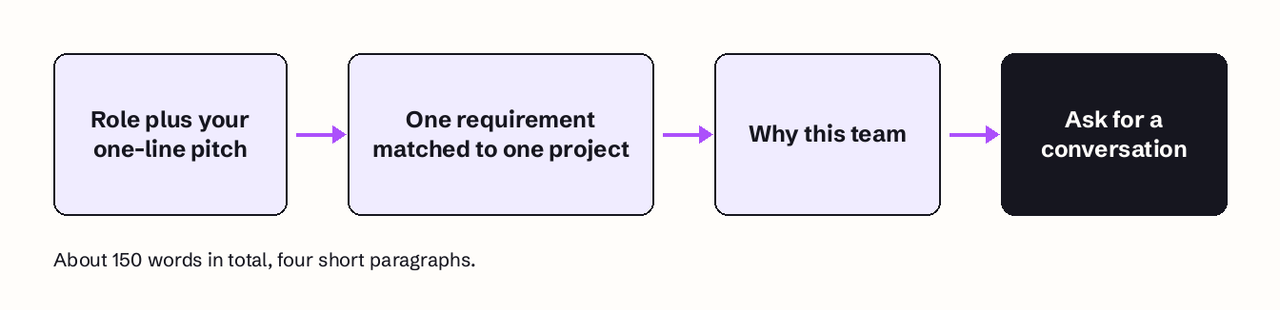
How to write a tech job cover letter in 6 steps
Follow these steps in order. Each one produces one or two sentences.
- Pick the requirement that matters most. Read the requirements list and choose the one the team will screen hardest on. Clues: it appears first, it appears twice, or it is the core of the role ("build and operate our Kafka pipelines", "own endpoint management for 400 laptops"). Harvard's career office gives the same instruction in general form: "Reference skills or experiences from the job description and draw connections to your credentials" (Harvard MCS).
- Write the opening line: role plus pitch. Name the exact job title, the reference number if the post has one (MIT notes HR uses it to track applications), and a one-line summary of what you do. For a data role: "I'm applying for the Data Engineer role, ref 7740. I build batch and streaming pipelines in Python and dbt."
- Match the requirement to one project. This is the paragraph that earns the interview. Use the shape requirement, what you built, how, result. For the same data role: "Your post asks for Airflow at scale. I split our nightly DAG into 40 parallel tasks, which cut the run from five hours to 70 minutes." One project, told specifically, beats five skills listed vaguely.
- Add a second proof only if it covers a different requirement. If the post has a second hard requirement you meet (on-call experience, a certification, a framework), give it one sentence. Otherwise stop. Repeating the resume is the most common mistake MIT warns against: the letter should "complement" the resume, not restate it.
- Write one honest sentence about why this team. Point to something specific and checkable, such as a talk, a repo or a post their engineers wrote about a problem you have solved. Skip "I'm passionate about innovation"; Harvard's advice is to "avoid flowery language."
- Close with a direct ask. Ask for a short call about the work itself. Then your name, email, GitHub or portfolio, and LinkedIn. Thank the reader in one line, as MIT suggests, and stop.
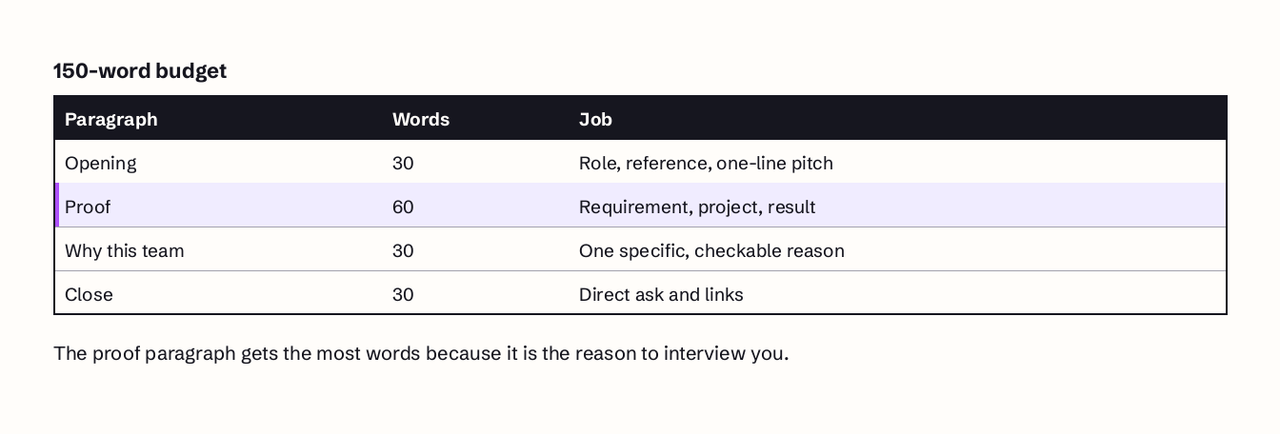
Software engineer cover letter example (150 words)
This example uses invented names and numbers. Replace every fact with your own.
Dear Priya Natarajan,
I'm applying for the Backend Engineer (Payments) role, REQ-2291. I'm a Python engineer who has spent three years building billing systems at a 40-person SaaS company.
Your post asks for experience scaling PostgreSQL under write-heavy load. Last year I moved our invoices table to monthly partitions and added a read replica for reporting. The billing dashboard's p95 query time dropped from 2.1 seconds to 300 ms, and month-end close stopped timing out. I also carry the on-call pager for that service, one week in five.
Your engineering blog's post on idempotent payment retries describes the exact bug class I spent last quarter removing from our Stripe webhooks, and I'd like to work on it at your scale.
I'd welcome a 20-minute call. Thank you for reading.
Alex Chen
alex@example.com | github.com/alexchen | linkedin.com/in/alexchen
That letter is about 150 words. A reader who spends 20 seconds on it learns the role, the match and the reason, which is all the letter has to do.
IT cover letter example (help desk and systems roles)
IT support and systems administration posts usually screen on platforms, volume and certifications rather than shipped code, so the proof paragraph changes shape: name the environment, the volume and the outcome.
Dear Hiring Manager,
I'm applying for the IT Support Specialist role at Northfield Clinics. I've spent two years on a help desk supporting 300 staff across three offices, and I hold CompTIA A+ and Network+.
Your post asks for Microsoft Intune and a ticketing workflow. I enrolled our 280 Windows laptops in Intune, wrote the setup runbook the team still uses, and handle about 25 tickets a day in Jira Service Management, most closed on first contact.
Clinics can't wait on IT, and your post's focus on uptime for scheduling systems is the part of the job I like most.
I'd welcome a conversation about the role.
Sam Rivera
The same rule applies: one requirement, one concrete proof, one reason, one ask.
How long should a tech cover letter be?
A tech cover letter should be 100 to 250 words; 150 is a good target. Both MIT and Harvard cap any cover letter at one page, and MIT gives a 10 to 12 point font range. General hiring-manager surveys suggest around 400 words (Resume Genius recommends about that), but engineering readers skim, and a letter that fits on one phone screen is more likely to be read to the end. When the form gives you a plain text box rather than a file upload, 150 words also avoids a wall of text. If you need more room, it is usually because you are listing skills the resume already shows; cut those first.
Where does your cover letter actually go? Greenhouse vs Lever forms
Where the letter lands depends on the applicant tracking system, and the top guides never mention this. Two of the most common systems in tech hiring handle it differently:
- Greenhouse has dedicated cover letter fields. Its public Job Board API accepts a cover letter as a file upload, a URL or plain text, next to the resume fields (Greenhouse API docs). When you see "Cover Letter: Attach / Enter manually" on a job form, that is Greenhouse.
- Lever has no dedicated cover letter field in its Postings API. Its apply endpoint takes a resume file, links (GitHub, LinkedIn, portfolio) and a free-text "comments" field described as "Additional information from the candidate" (Lever Postings API). On a Lever form, the "Additional information" box is your cover letter.
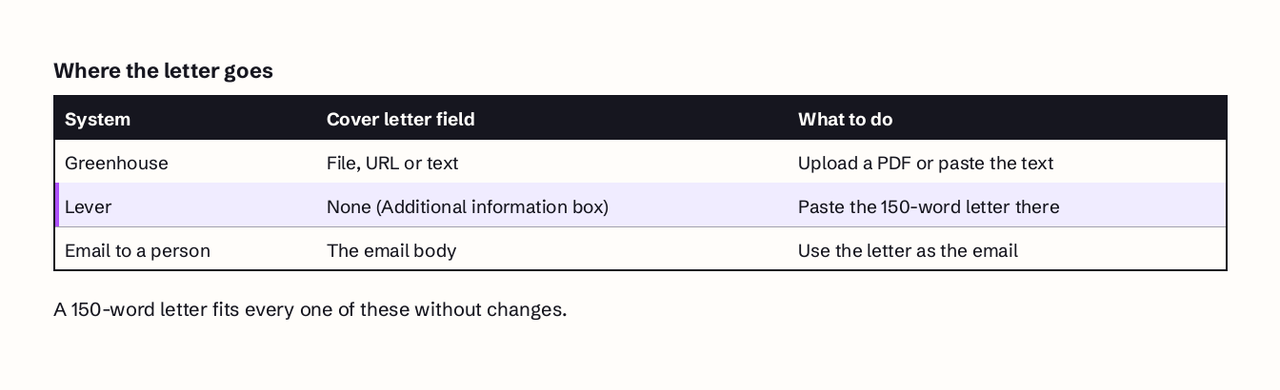
This is another reason to keep the letter short: the same 150 words work as a PDF upload, a pasted text box and an email body.
Is it better to email the hiring manager instead?
Often, yes: a short email to the engineering manager can do more than a letter uploaded to a portal, because it reaches a person who can move you forward. Do both. Apply through the form so you exist in the system, then send the same 150-word letter as an email to the hiring manager or the team lead, with one extra line saying you have applied and the role's reference number. Keep the subject line plain ("Backend Engineer (Payments) application, REQ-2291").
To find the right address, see our guide on how to find a hiring manager's email address. For timing and what to say if they don't reply, read how to email a hiring manager after applying.
How to check your letter before you send it
Run these five checks; together they take two minutes:
- The requirement test: can a stranger point to the exact line in the job post your proof paragraph answers? If not, rewrite it around that line.
- The number test: does your proof include at least one result someone could verify (a time, a count, a percentage, a size)?
- The swap test: if you replaced the company name with a competitor's, would the "why this team" sentence still be true? If yes, it is too generic.
- The length test: paste it into a word counter. Over 250 words means you are restating the resume.
- The name test: the company name, role title and reference number match this application. Copying letters between applications is how the wrong company name ends up in the first line.
Common mistakes and how to fix them
- Listing your stack. "Proficient in Java, Python, React, AWS, Docker" is already on your resume. Replace it with one project that used the stack the post asks for.
- Writing about what you want to learn. "I'm excited to grow my skills" tells the team what they give you. Say what you would build or fix for them.
- No result. "Worked on the payments service" says nothing. "Cut failed payment retries by moving them to an idempotent queue" says what you did.
- The generic template. Templates that start "As a long-time fan of the work of [company]" read as templates. Start with the role and your pitch.
- Hiding the career change. If you are moving into engineering from another field, say so in the opening line and use the proof paragraph for the project that bridges the two. That context is exactly what the letter is for.
Where JobFinder AI fits
The slow part of this process is step 1 and step 3 for every application: finding the requirement that matters and matching it to the right project from your history. The free JobFinder AI cover letter generator drafts a job-specific letter from a job description and your resume evidence. Treat its draft as a starting point: check every claim against what you actually did, trim it to about 150 words, and keep the "why this team" sentence in your own words.
FAQ
Do tech jobs even read cover letters?
Many tech hiring teams decide mainly from the resume and technical screens, but a share of hiring managers read letters even when they are optional. In a Resume Genius survey of 625 US hiring managers, 83% said they read most cover letters and 73% read them where they are not required. Write a short one when the form has a field, when a person reads applications, or when your resume needs context.
How long should a tech cover letter be?
Aim for about 150 words and never more than one page. MIT and Harvard both cap cover letters at one page. A 150-word letter fits a Greenhouse upload, a Lever "Additional information" box and an email body without changes.
What should a software engineer cover letter include?
The exact role title and reference number, one requirement from the job post matched to one project you shipped (with the stack and a measurable result), one specific reason you want this team, and a direct request for a call. Add links to GitHub or a portfolio under your name.
Is it better to email the hiring manager instead?
Do both. Apply through the official form so your application is in the tracking system, then send the same short letter as an email to the hiring manager or team lead and mention that you have applied. A direct email reaches the person who can move you forward.
Should I submit a cover letter when it says optional?
Yes, if you can write a specific one in 15 minutes. In the Resume Genius survey, 72% of hiring managers said they expect a cover letter even when it is optional. A generic letter adds nothing, so if you can't name a requirement and a project, skip it.
Can I use the same cover letter for every tech job?
Keep the structure, change the content. The opening line, the requirement you match and the "why this team" sentence must be specific to each post; only your sign-off and links stay the same.