What Does Under Consideration Mean on a Job Application?
Under consideration means your application is still active and no decision has been made. Here is what the status signals in Workday, USAJOBS, inspira and Indeed, and what to do next.
TL;DR: "Under consideration" means your application is still active and the employer has not made a final decision on it. It is not a rejection and not a shortlist; it only tells you that you have not been screened out yet. What it signals beyond that depends on which hiring system the employer uses and how they configured it.
The meaning of under consideration is simple: your application is in the employer's pool of live candidates, and nobody has closed it. In some systems the label appears the moment you apply and stays until someone is hired. In others it only appears after a recruiter or hiring manager has passed you through a first screen. The United Nations' inspira system, for example, shows "Under Consideration" to every applicant throughout shortlisting, interviews and recommendation, until a candidate is selected. A Workday tenant, by contrast, may only show it once you have cleared initial review. So treat the status as "still alive," then read the clues below to work out how alive.
What does "under consideration" mean, exactly?
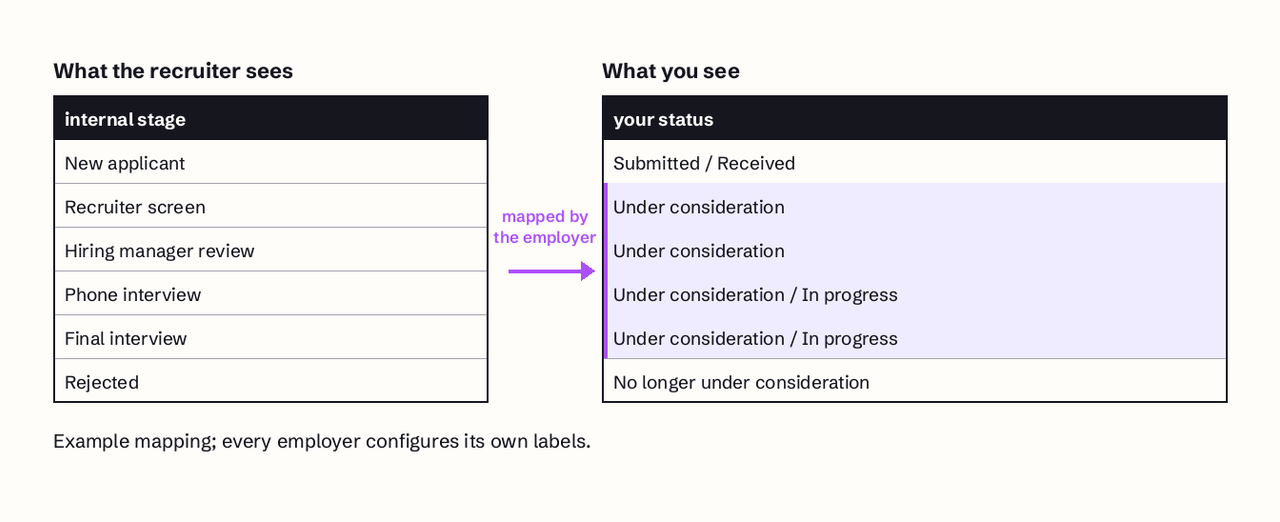
Under consideration is an applicant-facing status label that means your application has not been rejected, withdrawn or closed. It is a status you see, not necessarily the stage the recruiter sees. Applicant tracking systems (ATS) such as Workday, Taleo, iCIMS, Greenhouse and SuccessFactors keep a detailed internal pipeline (screen, phone screen, assessment, onsite, reference check, offer) and then map those internal stages onto a short list of public labels. Many internal stages often collapse into one public label.
That mapping is set by each employer. The University of Wisconsin-Madison's HR guide for its Workday setup shows this plainly: an application in the Review stage appears to the candidate as "Submitted," while any later active stage, including Interview, Assessment and Employment Agreement, appears as "In Progress." A rejection for any reason other than withdrawal shows up as "Completed" in the candidate's Inactive tab. The same guide notes that changing a candidate's status in Workday does not automatically notify the candidate; HR has to send a message separately (UW-Madison HR).
Two practical consequences follow:
- The same words mean different things at different companies. "Under consideration" at one employer is the default for every applicant; at another it means a human has already looked at you.
- A status can sit unchanged for weeks while real movement happens internally, because nobody is required to update the label you see.
Why does this status matter for your job search?
The status matters because it changes what you should do next, not because it predicts an offer. Consider a common scenario. You applied to a product analyst role on October 1. On October 3 the portal changed from "Received" to "Under consideration." It is now October 24 and nothing has moved.
If this employer shows "Under consideration" to everyone by default, the October 3 change may have been an automatic step, and 21 days of silence means very little. If this employer only uses the label after a human screen, the change tells you a recruiter has already kept you in the pool, and a short, specific follow-up to the recruiter or hiring manager is reasonable now.
The status does not tell you your rank, how many people are still in the pool, or whether the role has quietly been put on hold. A frozen requisition in Workday, per the UW-Madison guide, simply leaves your status as it was. That is why "under consideration" can persist for a role that is no longer actively hiring.
How does "under consideration" work across hiring systems?
Each major system uses its own vocabulary. These are the labels you are most likely to meet and what the source behind each says they mean.
Workday (Candidate Home). Labels vary by tenant. Common ones are Submitted, Under Consideration, In Progress, Interviewing, Offer, and Completed or No Longer Under Consideration. The University of Washington's guide notes external candidates see updates in their Candidate Home account and internal applicants in Jobs Hub (UW HR). "Completed" in the Inactive tab is usually a rejection or a canceled role, not a finished application.
USAJOBS (US federal jobs). The federal system is more literal. "Reviewing applications" means the announcement has closed and the agency is reviewing; it stays until the process is complete. "Referred" means HR found you met the minimum qualifications and sent your name to the hiring manager on a certificate. "Not referred" means you were not among the best qualified (USAJOBS Help). "Referred" is the closest federal equivalent to a meaningful "under consideration."
United Nations (inspira). "Under Consideration" appears to all applicants from the start of shortlisting through the interview and recommendation process, until someone is selected (UN HR portal). Here it carries almost no signal about your individual progress.
Amazon.jobs. "Under consideration" means the application is active and no decision has been made; "No longer under consideration" means you are out for that requisition. Applications to other Amazon roles are unaffected.
Indeed. Indeed's own tracker uses "Application viewed" when the employer has opened your application and "Not selected by employer" when they have rejected it (Indeed Help Center). These depend on the employer using Indeed's tools; many employers move candidates in their own ATS instead, so the Indeed status may never change.
Worked example: how long is "under consideration" normal?
A useful benchmark is how long employers take to fill roles. SHRM's 2025 Recruiting Benchmarking Report puts the median time to fill at 44 calendar days for nonexecutive roles and 45 for executive roles (SHRM, 2025). Greenhouse's Hire Standard data reports time to fill rising from 43.64 days in 2022 to 59.67 days in 2025, a 37% increase, and Ashby reports medians of around 30 days for business roles and 40 for technical ones.
Now apply it. Say a posting went live on September 15 and you applied on September 22, a week in. With a 44-day median, a typical hire for that role lands around October 29. If it is October 10 and you are still "under consideration" with no contact, you are roughly 18 days into your own application and about 25 days into the role's process: well within normal. If it is November 20 and nothing has changed, you are past the median by 22 days. At that point either the role has slowed or stalled, someone else is at offer stage, or your application was never actively reviewed.
That gives you a rough rule built from real numbers:
- Under 21 days since applying: normal. Keep applying elsewhere.
- 21 to 42 days: send one short follow-up if you have a named contact.
- Past about 60 days with no contact: treat it as inactive, even if the label never changes.
Our guide on how long it takes to find a job covers the wider timeline if you are planning a full search.
Under consideration vs. under review vs. in progress: what is the difference?
These three labels overlap, and the difference is set by each employer. In general use:
- Under review usually means a person or a screening rule is looking at your application right now, often the first pass. Some portals use it the moment you apply.
- Under consideration usually means you were not screened out and remain in the pool of possible candidates. In some systems it comes after review; in others it is the default from day one.
- In progress in Workday setups like UW-Madison's means you are in any active stage past initial review, which often includes interviews.
- No longer under consideration, Completed or Not selected means the application is closed for that role. It is final for that requisition, not for the company.
If two labels both appear in the same portal, the later one in this list is generally the better sign. If only one label ever appears, it carries little information on its own.
What should you do while your application is under consideration?
Use the waiting time to raise your odds, not to refresh the portal.
- Note the date the status changed. A change 1 or 2 days after applying, outside business hours, is often automatic. A change during the workday after a week or more is more likely a human decision.
- Find a real person. The recruiter named on the posting, or the hiring manager on LinkedIn. Our guide to finding a hiring manager's email address walks through the search.
- Send one specific follow-up after about 14 days. Name the role, add one concrete proof point relevant to the job, and ask a simple question. Avoid "just checking in" with nothing new.
- Keep applying. An active status reserves nothing. If you have not had interviews in a while, why you might not be getting interviews is a better use of the time.
- Track every application in one place, including the status, the date it changed and the last contact. A simple job application tracker stops you from following up twice or not at all.
If you are juggling dozens of applications across Workday, Greenhouse and USAJOBS portals, this is where tooling helps. JobFinder AI finds matching roles, tracks where each application stands and helps you reach the hiring manager directly, so a stalled portal status is not your only line to the employer. You can try JobFinder AI here.
Is "under consideration" a good sign?
It is a neutral-to-good sign. It is good in the narrow sense that you have not been rejected, and some candidates are rejected within hours by knockout questions or automated filters. It is neutral because, in systems like inspira and many Workday setups, everyone who applied sees the same label.
Signs that your "under consideration" is meaningful:
- The status changed from an earlier label (Received, Submitted) to "under consideration" after a human-sized delay.
- You received a message, an assessment link or a scheduling request.
- In USAJOBS, your status reads "Referred."
Signs that it means little:
- It appeared instantly when you applied.
- It has not changed in more than about 60 days.
- The posting has been taken down or re-posted with a new requisition number.
Common pitfalls when reading application statuses
- Assuming the portal is current. As the UW-Madison guide notes, status changes do not notify candidates automatically, and many recruiters never touch the candidate-facing label.
- Reading "Completed" as good news. In Workday it usually means the application was closed, often a rejection.
- Following up too often. One follow-up at around 14 days and one more about 14 days later is enough. More rarely helps.
- Pausing your search. No status, including "interviewing," is a commitment from the employer.
- Withdrawing too early. If a better offer is not on the table yet, an active application costs you nothing.
FAQ
How long does an application stay under consideration?
Usually until the role is filled, canceled or you are rejected. With a median time to fill of 44 days in SHRM's 2025 data, 28 to 56 days is common. Some portals never update the label after a role closes, so treat anything past about 60 days with no contact as inactive.
What does no longer under consideration mean?
It means the employer has closed your application for that specific role. It is usually a rejection, though it can also appear when a role is canceled or filled. It does not stop you from applying to other roles at the same company.
Should I follow up while my application is under consideration?
Yes, once, about 14 days after applying, and only if you can reach a named recruiter or hiring manager. Keep it short, mention the role and add one relevant proof point. Following up through the portal itself rarely reaches a person.
Does under consideration mean I got an interview?
No. It means you have not been rejected. In federal hiring, the closer signal is "Referred," and in most systems the real signal is a direct message or a scheduling request from a recruiter.
Can an application go from under consideration back to active interviewing?
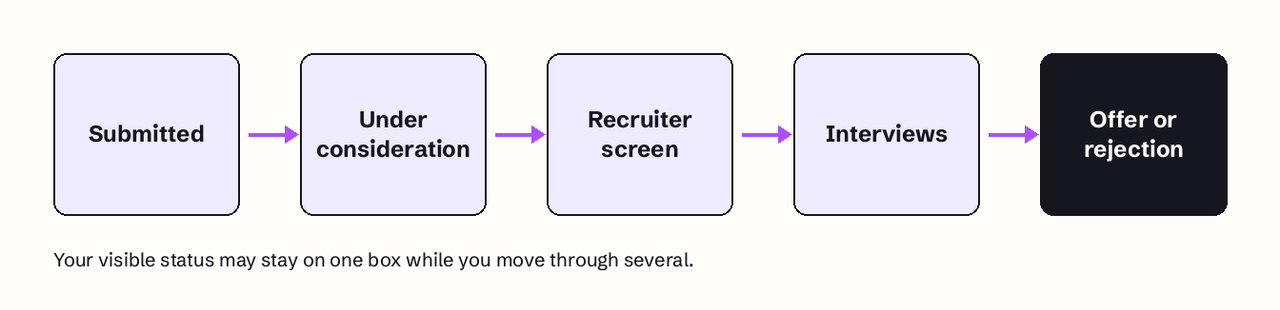
Yes. Because many internal stages map onto one visible label, you can move from screen to interviews without the status changing at all. Recruiters often contact you by email or phone well before the portal updates.