Words for Resume to Describe Yourself, With Proof
Words to describe yourself on a resume, grouped by the trait a job posting asks for, each paired with the proof that makes it believable, plus 12 free sources.
TL;DR: The best words for a resume to describe yourself are the traits the job posting already asks for, such as analytical, dependable, adaptable or collaborative. Use two or three of them in your summary, then prove each one with a bullet that shows a result. Below are words grouped by trait, the proof each needs, words to avoid, and 12 free sources for finding more.
Good words to describe yourself on a resume are specific, relevant to the role and backed by evidence: "analytical" next to a bullet about a report that changed a decision, "dependable" next to a record of on-time delivery. Employers are not short of adjectives. They are short of proof. In the National Association of Colleges and Employers (NACE) Job Outlook 2025 survey, nearly 90% of employers said they look for evidence of problem-solving on resumes and nearly 80% look for teamwork. So pick the trait from the job description, put the adjective in your summary, and let your experience section do the convincing.
How should you choose words to describe yourself on a resume?
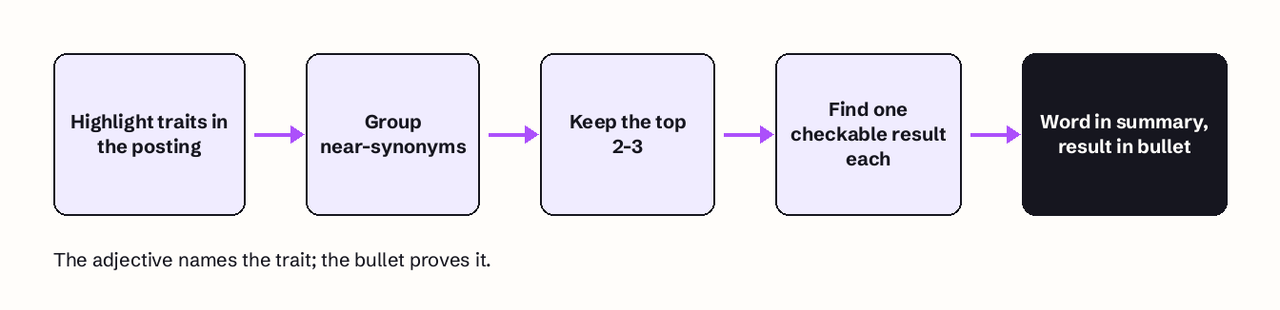
Choose words by reading the job description first, not a thesaurus. Most postings name the traits they want in the requirements or the "about you" section. Circle every trait, group the near-synonyms ("detail-oriented", "meticulous", "accurate"), and keep the two or three that appear most often and that you can prove.
A quick method that works for any role:
- Copy the posting into a document and highlight every adjective and soft skill.
- Group them by trait: reliability, analysis, leadership, collaboration, adaptability, creativity, communication.
- Pick the two or three groups the posting repeats.
- For each, write down one result from your work that a stranger could check: a number, a deadline, a before and after.
- Use the posting's own word in your summary and the result in a bullet.
This is also how an applicant tracking system and a recruiter skim: they look for the posting's language, then for evidence. If you want to see how closely your resume mirrors a specific posting, our guide to a resume scanner with a job description walks through the comparison.
Words to describe yourself, grouped by trait (with the proof each needs)
Each group below pairs the words with the kind of evidence that makes them believable. The trait names follow two public frameworks: the O*NET Work Styles maintained by the U.S. Department of Labor, and NACE's eight career readiness competencies.
Reliability and work ethic
- Words: dependable, reliable, conscientious, accountable, consistent, thorough, punctual, diligent.
- Proof it needs: a record over time. Deadlines met, error rates, coverage you handled, responsibilities you kept for months.
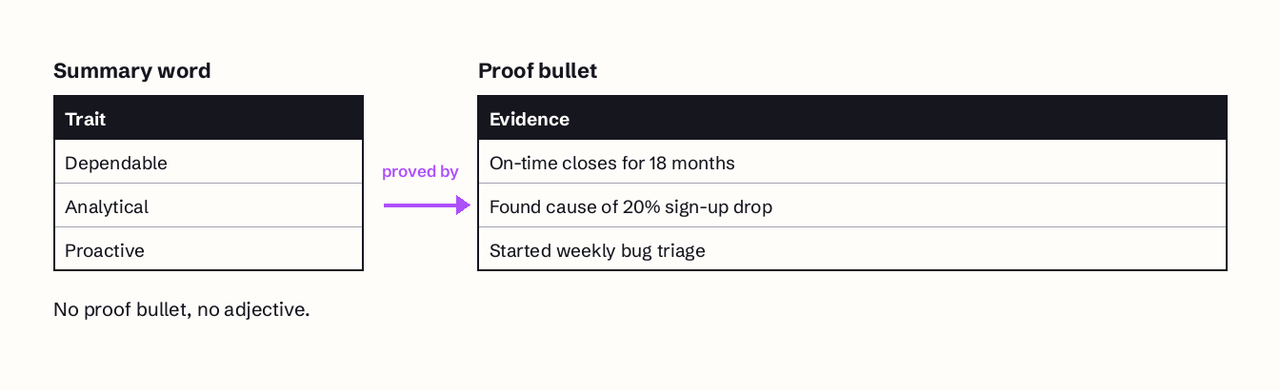
- Example: "Dependable operations coordinator" in the summary, backed by "Closed 100% of month-end vendor reconciliations on schedule for 18 months."
O*NET files "Dependability" and "Attention to Detail" under its Conscientious and Rule Oriented group, defined as being "reliable, responsible, and consistent in meeting work-related obligations."
Analysis and problem-solving
- Words: analytical, data-driven, resourceful, methodical, logical, investigative, detail-oriented, precise.
- Proof it needs: a problem, what you analyzed, and the decision or fix that followed.
- Example: "Analytical marketing associate" backed by "Traced a 20% drop in sign-ups to a broken form field and restored conversion within 5 days."
This is the trait employers ask for most often in the NACE data, so if the posting mentions it at all, put it in your summary.
Leadership and initiative
- Words: proactive, self-starter, decisive, driven, entrepreneurial, motivated, ambitious, take-charge.
- Proof it needs: something you started that nobody assigned, or people you led and what they delivered.
- Example: "Proactive support lead" backed by "Started a weekly bug triage with engineering that cut repeat tickets on the top issue by 50%."
O*NET lists Initiative ("take on extra responsibilities and tasks that may fall outside of one's required work role") and Leadership Orientation as separate styles. If you have never managed people, lean on initiative rather than calling yourself a leader.
Collaboration and teamwork
- Words: collaborative, cooperative, supportive, diplomatic, team-oriented, approachable, empathetic.
- Proof it needs: a cross-team result, a conflict you resolved, or people you trained.
- Example: "Collaborative project coordinator" backed by "Ran handoffs between three regional teams for a product launch delivered on the agreed date."
NACE's 2026 Job Outlook Spring Update puts teamwork at 85% of employers looking for it on the resume.
Adaptability and resilience
- Words: adaptable, flexible, versatile, resilient, composed, calm under pressure, quick learner.
- Proof it needs: a change you absorbed and still delivered through: a new system, a reorganization, a role that grew.
- Example: "Adaptable account manager" backed by "Took over 30 accounts mid-quarter after a reorganization and renewed 28 of them (93%)."
O*NET separates Adaptability, Stress Tolerance and Tolerance for Ambiguity. Pick the one the posting describes: a startup posting usually means ambiguity, a hospital or support posting usually means stress.
Creativity and innovation
- Words: creative, innovative, inventive, curious, imaginative, original, experimental.
- Proof it needs: something you made or changed that did not exist before, and what it did.
- Example: "Curious product designer" backed by "Prototyped a self-serve onboarding flow that replaced a manual setup call."
Communication
- Words: articulate, persuasive, clear, concise, personable, engaging, well-spoken.
- Proof it needs: an audience and an outcome: a presentation that won approval, documentation people used, a negotiation.
- Example: "Persuasive sales engineer" backed by "Presented technical demos to procurement panels at 12 enterprise prospects."
NACE splits this into written and verbal communication, and both appear in its list of attributes most employers want. Writing samples, reports and documentation count as proof of the written kind.
How many adjectives should a resume summary use?
Use two or three adjectives in a resume summary, and no more than one per sentence. A summary of three or four lines has room to name your role, your strongest two traits and one headline result. Five adjectives in a row ("motivated, dynamic, detail-oriented, results-driven team player") reads as filler, and none of them gets proof.
A simple pattern:
- [Adjective] [job title] with [years] of experience in [area].
- [Second adjective] about [what you care about at work], shown by [one result].
For example: "Analytical operations specialist with five years in logistics. Dependable under deadline pressure, with 18 months of on-time month-end closes and a 99% invoice accuracy rate." Your title line matters as much as the adjectives; see our resume title examples for wording that matches the posting.
Outside the summary, keep adjectives rare. Experience bullets should start with action verbs (led, built, reduced, negotiated), as MIT CAPD and Harvard both advise.
How do you prove a trait instead of claiming it?
You prove a trait by showing the behaviour it produces, with something a reader can check. Harvard's Mignone Center for Career Success puts it as "written to express not impress": specific rather than general, fact-based, and quantified where possible.
Four ways to turn a claim into proof:
- Use a number. Volume, percentage, time saved, money, people, accounts. "Resolved 60 tickets per day" proves "efficient" better than the word does, and "cut weekly report prep from 6 hours to 2 hours" proves "resourceful".
- Show duration. Reliability is a pattern, so give the time frame: "for two years", "every quarter".
- Name the stakes. Who depended on the work? A launch, an audit, a client renewal.
- Show the before and after. "Replaced a manual spreadsheet with a shared tracker used by 15 staff" proves resourcefulness without the word.
If you have no numbers, use scope ("sole point of contact for 40 vendors"), recognition ("chosen to train new hires") or frequency ("weekly"). Never invent figures: a number you can't explain in an interview does more harm than a vague bullet. Our piece on whether it is illegal to lie on a resume covers where exaggeration becomes a real risk.
What should you avoid: cliches, weak verbs and pronouns?
Avoid words that every applicant uses and nobody can verify, words that undercut you, and words that don't belong in professional writing.
- Clichés with no proof: hardworking, team player, go-getter, results-driven, think outside the box, synergy, rockstar, ninja, guru.
- Weak verbs: "responsible for", "helped with", "worked on", "assisted in" (say what you did instead).
- Personal pronouns: I, me, my, we. Harvard's guide lists them under "Don't".
- Hedges: "some experience with", "familiar with" (unless the posting uses that phrasing for a skills list).
- Personal details: age, marital status, gender. Harvard's guide also advises leaving these out.
- Flowery or slang words: "passionate" stacked on "enthusiastic", or casual words like "awesome".
"Results-driven" and "detail-oriented" are not banned. They become fine the moment a bullet beneath them proves them. The problem is the adjective with nothing behind it.
Resources for finding the right words (all free)
These are the sources worth opening when you need more words or want to check that a trait means what you think it means.
Trait and competency frameworks
- O*NET Work Styles: the U.S. Department of Labor's list of work styles with plain definitions. Best for checking what a trait actually means at work.
- O*NET OnLine: search any occupation to see which work styles it rates as most important. Best for choosing traits for a role you haven't held yet.
- NACE career readiness competencies: eight competencies with sample behaviours for each. Best for students and early-career applicants who need proof ideas.
- NACE: what employers look for on resumes: the survey data behind the problem-solving and teamwork numbers above.
- My Next Move: the O*NET data in a simpler interface, with personality and skills listed per career. Best for career changers.
Action verb and resume writing guides
- MIT CAPD resume action verbs: verbs grouped by skill (management, financial, communication and more). Best for starting experience bullets.
- Harvard Mignone Center resume guide: a verb list by category plus do and don't rules for resume language.
- Berkeley Career Engagement: resumes: how to tailor wording to a position description, with an FAQ on format.
- Purdue OWL resumes and CVs: writing-centre guidance on resume sections and language.
Writing tools
- Hemingway Editor: flags long sentences and passive voice. Useful for trimming a summary.
- LanguageTool: grammar and style checking with a free tier, useful for catching repeated words.
- Google Books Ngram Viewer: shows how common a word is in published English. Handy when deciding between two synonyms.
Start here (a 20-minute path)
- Open the job posting and highlight its traits (5 minutes).
- Look up each trait in O*NET Work Styles to confirm the meaning (3 minutes).
- Choose two or three you can prove and write the proof bullets (7 minutes).
- Borrow verbs from MIT or Harvard for the rest of your bullets (3 minutes).
- Run the summary through Hemingway and cut anything it flags as hard to read (2 minutes).
Words to describe yourself for different situations
The same trait can be worded differently depending on your stage and target.
- Entry level or students: eager, coachable, quick learner, curious, organized. Proof comes from coursework, projects, volunteering and part-time work. Our guide to volunteer experience on a resume shows how to list it.
- Career changers: adaptable, transferable, versatile, resourceful. Name the skill that carries over and the result it produced in your old field.
- Managers and senior roles: strategic, decisive, accountable, cross-functional. Proof is team size, budget and business outcomes.
- Technical roles: precise, methodical, systematic, analytical. Proof is what you built, its scale and its reliability.
- Customer-facing roles: personable, patient, empathetic, composed. Proof is satisfaction scores (such as 4.8/5 CSAT), retention or volume handled (such as 80 calls per shift).
Once your wording is set, the slow part is repeating it for every application, since each posting asks for slightly different traits. JobFinder AI can match your resume to live roles and tailor each application to the posting's own language, so the traits you lead with fit each job you send.
FAQ
What are three good words to describe yourself on a resume?
Three good words are the three traits the job posting emphasizes most that you can prove. For many roles that means one analytical word (analytical, resourceful), one reliability word (dependable, accountable) and one people word (collaborative, articulate), each backed by a bullet with a result.
Should I use adjectives on my resume at all?
Yes, sparingly. Two or three adjectives in the summary help a recruiter see the match at a glance. In the experience section, start bullets with action verbs and let results carry the traits.
Is "detail-oriented" a cliché?
It is overused when it stands alone. Paired with proof, such as an accuracy rate or an audit with no findings, it is a useful keyword, especially when the posting itself asks for attention to detail.
Can I use the same words on my resume and in an interview?
Yes, and you should. If your resume calls you adaptable, prepare a short story about a change you handled. The STAR method in our STAR interview method guide is a simple way to structure it.
How do I describe myself if I have no work experience?
Use traits that coursework, projects, volunteering or caregiving prove: organized, reliable, curious, quick learner. Give the setting and a result, such as "organized a 50-person campus event" or "kept a project team on schedule over a semester".