XYZ Resume Format: 20 Examples (With a Template)
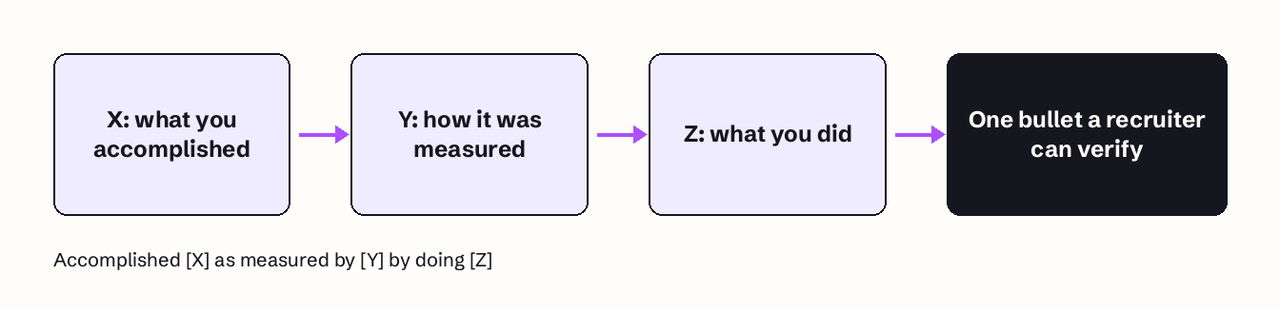
The XYZ resume format writes each bullet as Accomplished X as measured by Y by doing Z. Here are 20 before-and-after examples, including roles without hard numbers.
TL;DR: The XYZ resume format writes every achievement bullet as "Accomplished [X] as measured by [Y] by doing [Z]": the result, the measure that proves it, and the action that caused it. It comes from Laszlo Bock, then Google's SVP of People Operations, in 2014. Below are 20 before-and-after XYZ resume bullet examples, including roles with no hard numbers, plus a template you can fill in.
The XYZ resume format is a way to write experience bullets, not a whole resume layout. You keep a normal reverse-chronological resume and rewrite each bullet so it states what you accomplished (X), how that was measured (Y) and what you did to get there (Z). Laszlo Bock published the formula in his LinkedIn post "My Personal Formula for a Winning Resume" on September 29, 2014, and Google's own recruiters still teach it as "accomplish X as measured by Y by doing Z" in the Life at Google resume video. Bock's own one-line summary: start with an active verb, measure what you accomplished, give a baseline for comparison, and say what you did.
The numbers in the examples below are illustrations of shape, not benchmarks. Use your real figures, or one of the no-number substitutes in section 3.
What is the XYZ resume format?
The XYZ resume format is a bullet formula with three parts:
- X, the accomplishment: what changed because of you, starting with a strong verb (grew, cut, launched, reduced, won).
- Y, the measure: the number, comparison or evidence that proves X happened. A percentage, money, time, volume, rank or a recognition.
- Z, the action: how you did it. This is where your skill shows.
Bock's own before-and-after shows why it works. "Studied financial performance of companies and made investment recommendations" becomes "Improved portfolio performance by 12% ($1.2M) over one year by refining cost of capital calculations for information-poor markets and re-weighting portfolio based on resulting valuations." He points out that the "$1.2M" answers the reviewer's next question: 12% of $100 is $12, which is not impressive; 12% of a $10 million portfolio is.
Did Google create the XYZ formula?
Google did not publish it as a company standard; Laszlo Bock did, while he ran People Operations at Google. The wording also shifted across his own statements:
- In a 2014 New York Times interview with Thomas Friedman, quoted by Quartz, he said: "I accomplished X, relative to Y, by doing Z", with an op-ed writer example of "50 op-eds published compared to average of 6".
- In the September 2014 LinkedIn post: "Accomplished [X] as measured by [Y] by doing [Z]".
- In an April 2015 Reddit AMA, reported by Government Executive: "accomplished X by doing Y as measured by Z".
The order matters less than the three ingredients. The "relative to Y" version is the most useful reminder: a number needs a baseline. Google's recruiters repeat this in their 2019 video ("use data and comparisons or averages to provide context"), so it is fair to call it Google's XYZ formula as long as you know it is one executive's advice, not a hiring rule.
Two Google recruiters explain why bullets should show results and impact, introduce the "accomplish X as measured by Y by doing Z" framework, and rebuild a technical bullet, a business account bullet and a leadership program bullet step by step.
What does an XYZ resume template look like?
Copy this, then fill in each slot from your notes:
[Strong verb] [what improved] by [number or comparison] [over what time or against what baseline] by [the specific thing you did].
Two shortcuts that keep bullets tight:
- Write Z first. List what you actually did in a role, then ask "so what changed?" for each item. That answer is X.
- Add Y last, and add the baseline with it. "Cut ticket backlog 40%" is weaker than "Cut ticket backlog 40% (from 500 to 300 open tickets)".
Keep each bullet to one or two lines. Google's recruiters suggest trimming bullets that spill onto a new line by only a word or two.
What are good XYZ resume bullet examples? 20 by role
Each example shows a typical bullet, then the XYZ rewrite, then how to adapt it.
1. Software engineer
Before: Worked on backend APIs. After: Reduced p95 API latency from 800 ms to 320 ms for the checkout service by adding a read-through cache and removing two blocking database calls. Adapt: swap latency for error rate, build time or cost per request.
2. Data analyst
Before: Built dashboards for the sales team. After: Cut weekly sales reporting from 6 hours to 30 minutes by replacing manual spreadsheet exports with a scheduled dashboard used by 25 reps. Adapt: time saved is a valid Y when revenue is not yours to claim.
3. Product manager
Before: Managed the onboarding roadmap. After: Raised trial-to-paid conversion from 9% to 12% in one quarter by shipping a three-step onboarding checklist based on 20 user interviews.
4. Sales representative
Before: Responsible for mid-market accounts. After: Closed $1.4M in new annual contract value, 118% of quota, by building a referral play with existing customers in the logistics vertical.
5. Marketing manager
Before: Ran email campaigns. After: Grew newsletter-sourced demo requests 35% quarter over quarter by segmenting the list by industry and rewriting four nurture emails.
6. Customer support specialist
Before: Answered customer tickets. After: Kept a 96% satisfaction score across 1,200 tickets in 2025, against a team average of 89%, by writing 15 help articles for the most repeated questions.
7. Project manager
Before: Coordinated the office move. After: Delivered a 120-person office move one week early and 8% under its $200k budget by sequencing vendors on a shared timeline with weekly risk reviews.
8. Operations or logistics lead
Before: Managed warehouse inventory. After: Reduced excess and obsolete stock 20% ($150k) in 12 months by introducing monthly cycle counts and reorder points for the top 200 SKUs.
9. Recruiter
Before: Sourced candidates for engineering roles. After: Shortened average time to fill for engineering roles from 52 to 38 days by building a referral pipeline and a structured phone screen.
10. Finance analyst
Before: Prepared monthly forecasts. After: Improved forecast accuracy to within 3% of actuals, from 9%, by rebuilding the driver model around booked pipeline instead of trailing averages.
11. Teacher
Before: Taught 10th grade math. After: Lifted the share of students passing the state algebra exam from 61% to 74% by adding weekly low-stakes quizzes and small-group reteaching.
12. Nurse
Before: Provided patient care on a surgical unit. After: Helped cut patient falls on a 30-bed surgical unit by a third over six months by leading hourly rounding and bed-alarm checks on night shift.
13. Designer
Before: Designed the mobile app. After: Reduced checkout drop-off 18% by redesigning the payment screen after usability tests with 12 customers.
14. Writer or content marketer
Before: Wrote blog posts. After: Grew organic blog visits from 4,000 to 15,000 a month in a year by publishing 40 articles mapped to customer support questions.
15. Executive assistant
Before: Managed the CEO's calendar. After: Freed about 5 hours a week of the CEO's time by triaging meeting requests against quarterly priorities and batching one-on-ones.
16. Student or recent graduate
Before: Treasurer of the student society. After: Managed a $31,000 annual society budget and finished 6% under plan by moving event bookings to off-peak venues.
17. Career changer
Before: Retail store manager. After: Raised store sales 14% year over year, ranking 3rd of 40 stores in the region, by scheduling staff against hourly footfall data, the same analysis skills I now apply to operations roles.
How do I use XYZ when I have no numbers?
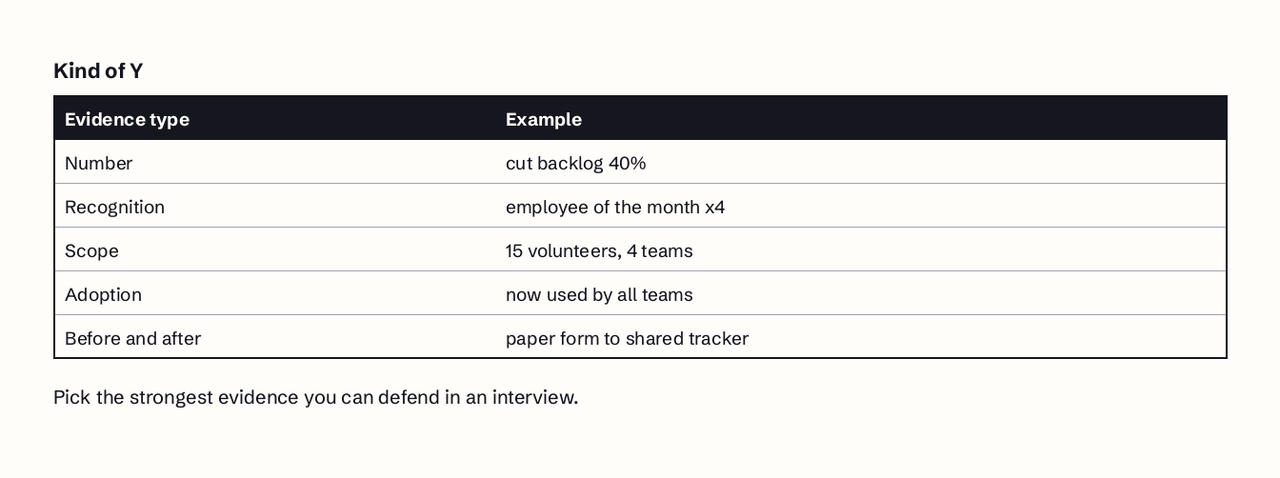
Use a different kind of Y. The formula needs evidence, and numbers are only one kind. Bock's own post includes a skills bullet with no metric: "Excellent customer service skills and positive attitude as demonstrated by receiving employee of the month in four consecutive months in 2014." Good substitutes:
- Recognition: an award, a promotion, being chosen for something ("selected as one of 230 participants nationwide").
- Scope: how many people, sites, clients or products the work touched.
- Rank or comparison: "fastest onboarding in the team", "first in the region".
- Adoption: "now used by all five regional teams", "made the standard template".
- Before and after state: "replaced a paper process with a shared tracker".
- Honest estimates: "about 5 hours a week" is fine if you can explain how you got it in an interview.
Three examples from roles where hard numbers are rare:
18. Administrative coordinator
Before: Handled office supplies. After: Replaced ad hoc supply orders with a shared request form adopted by all four departments, ending the monthly stockouts of printer and kitchen supplies.
19. Volunteer or community organizer
Before: Volunteered at the food bank. After: Recruited and scheduled a rota of 15 weekend volunteers, which let the food bank add a Sunday distribution shift.
20. Junior engineer with internal tooling work
Before: Wrote scripts for the team. After: Automated the release checklist with a script that the whole team of eight now runs before every deploy, removing the most common missed step.
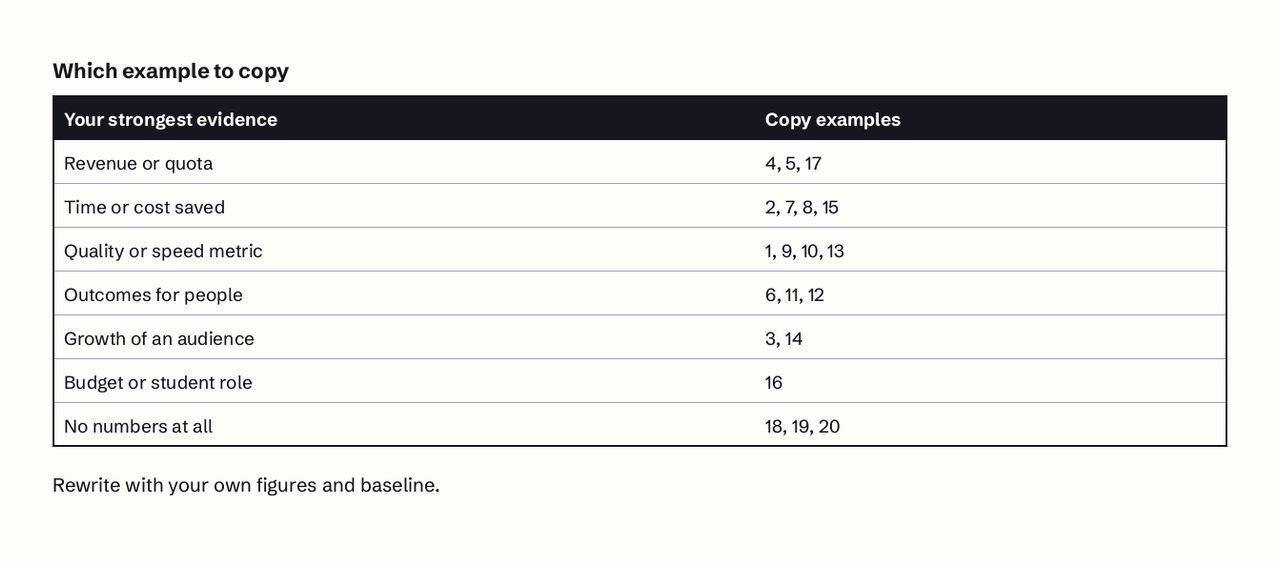
Which example should you copy?
Pick by what you can prove, not by your job title.
Should every bullet use XYZ?
No. Use it for the two or three bullets per role that best match the job, and let the rest be short. A resume where every line has the same "by doing" ending reads like a template, and some work (scope of a role, tools you used, certifications) is better stated plainly. The XYZ bullets carry the proof; the plain bullets give context.
A practical split for each job:
- Top 2-3 bullets: full XYZ, matched to the posting's main requirements.
- Next 1-2 bullets: shorter, result plus action, no metric needed.
- Skills, tools and credentials: in the skills section, not forced into bullets.
Read the posting first. Google's recruiters say to use the job description's own language and to tailor the resume to each role; our guide on how to read a job description shows how to pull out the requirements that deserve an XYZ bullet.
XYZ vs STAR and CAR: what is the difference?
XYZ, STAR (Situation, Task, Action, Result) and CAR (Challenge, Action, Result) all tie an action to a result. The difference is the job:
- XYZ is for a resume line. It leads with the result and forces a measure, so it fits in one or two lines.
- STAR is for interview answers. It gives the situation and task first because a listener needs context. See our Amazon STAR interview answers for worked examples.
- CAR sits in between: shorter than STAR, but without XYZ's explicit "measured by".
A good habit is to write the STAR story for each XYZ bullet. If a recruiter asks "how did you get that 12%?", the story is ready.
What are the most common XYZ mistakes?
- A number with no baseline. "Increased sales 200%" from 2 sales to 6 is not the claim it sounds like. Bock's own advice was to give a baseline for comparison.
- Inflated or invented figures. Every number on the page is an interview question. Use what you can explain; our guide on whether it is illegal to lie on a resume covers where the real risk lies.
- Claiming a team result as yours alone. Write "as one of three engineers" or "contributed to". Bock's sales support example opens with "As a team member, contributed to 21% increase in advertiser spend".
- Z that is a job duty, not an action. "By being responsible for accounts" says nothing. Name the decision, method or tool.
- Bullets that run three lines. Cut the adjectives first, then the least important number.
Applicant tracking systems read XYZ bullets like any other text, so the formula does not hurt parsing. What matters for them is that your bullets use the posting's words; our ATS resume scanner guide explains what they check. For length, see how long a resume should be.
Once your best bullets are written, the slow part is choosing which ones lead for each job you apply to. JobFinder AI can match your resume to live roles and tailor each application to the posting's language, so the XYZ bullets that fit each job come first.
FAQ
What does XYZ stand for in a resume?
X is what you accomplished, Y is how it was measured, and Z is what you did to achieve it. The full sentence is "Accomplished [X] as measured by [Y] by doing [Z]", from Laszlo Bock's 2014 LinkedIn post.
Is the XYZ resume format only for Google applications?
No. Bock described it as advice for any resume, and the result-measure-action structure works for any employer that screens resumes for impact. Google's recruiters teach it in their own video, which is why it is often called the Google XYZ formula.
What if my results are confidential?
Use percentages, ranges or relative measures instead of exact figures: "grew a key account 30%" rather than the dollar amount, or "one of the top five accounts by revenue". Never publish a number your employer considers confidential.
How many XYZ bullets should each job have?
Two or three for recent, relevant roles is usually enough, with shorter bullets for older roles. Google's recruiters suggest one page for business and internship resumes and no more than two pages for engineering roles, so space limits the count anyway.
Can I use XYZ in a resume summary or LinkedIn profile?
Yes. A one-line XYZ achievement in your summary or LinkedIn About section works well as a headline proof point. Pair it with a clear resume title so the reader knows the role first.
Does the order of X, Y and Z matter?
Not much. Bock himself used "as measured by Y by doing Z" in 2014 and "by doing Y as measured by Z" in 2015. Lead with the result, keep the measure next to it, and make sure the action is specific.