Job Search Checklist: 37 Steps With Free Tools
A four-stage job search checklist: set up once, check every application, follow up after interviews, verify offers. 37 steps with the free tools and sources for each.
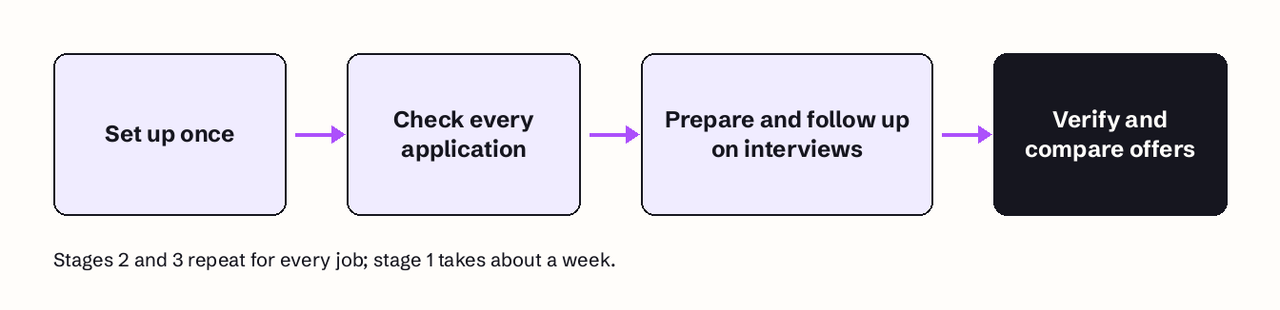
TL;DR: A good job search checklist has four stages: set up once (target, resume, profile, tracker), check every application before you send it, follow up after every interview, and verify every offer. Below are 37 steps, most linked to the free tool, template or official source that gets them done, so the checklist is something you work through, not just read.
A job search checklist is a list of the tasks that move you from "I need a new job" to a signed offer, in the order you do them. The essentials: pick 1 or 2 target roles and 10 to 20 target companies, build one master resume and tailor it per job, set up a tracker, check each posting for fit and scams before applying, contact the hiring manager, prepare stories for each interview, follow up within 24 hours, and compare offers on total pay and terms before accepting. Most checklists that rank today are university handouts and generic tips lists. This one is built for working through: every item has a link to something that does the work.
Start here: the 10-minute version
If you only do five things this week, do these:
- Write down 1 or 2 target job titles and your minimum salary.
- List 10 to 20 companies you would actually want to work for.
- Update one master resume and keep it to two pages or fewer.
- Start a tracker (a spreadsheet is enough). Our Google Sheets job search tracker has the columns ready.
- Apply to 3 well-matched roles and email the hiring manager for each.
The rest of this page expands those five into the full list.
Stage 1: What should you do before you start applying?
Set your target, your materials and your system once, before the first application. Skipping this is why searches drift into hundreds of untailored applications.
Target
- Pick 1 or 2 job titles and check what they involve on O*NET OnLine: the US Department of Labor's database of 923 occupations, with the tasks, skills and software each one uses. Use its wording in your resume.
- Check pay and outlook for those titles in the BLS Occupational Outlook Handbook: median pay, job growth and typical education per occupation, updated each year.
- Look up local salary ranges with CareerOneStop, sponsored by the US Department of Labor, which also has free resume and interview guides.
- For tech roles, compare levels and total compensation on Levels.fyi, which collects self-reported offers by company and level.
- Write your non-negotiables: minimum base pay, remote or on-site, location, visa needs.
- Build a target list of 10 to 20 companies and set Google Alerts for each name plus "hiring" or "funding".
Materials
- Update one master resume with every result you can quantify. Harvard's resume guide has a clear structure and an action-verb list.
- Applying for US federal jobs? Since September 27, 2025, USAJOBS rejects resumes longer than two pages (OPM guidance).
- Rewrite your LinkedIn headline around the target role. The free LinkedIn headline generator gives you several options from your real experience.
- Decide on Open to Work visibility. "Recruiters only" shows it to people using LinkedIn Recruiter, but LinkedIn's help page says it "can't guarantee complete privacy" from recruiters at your current company.
- Choose three references and ask them now, not when an offer depends on it.
System
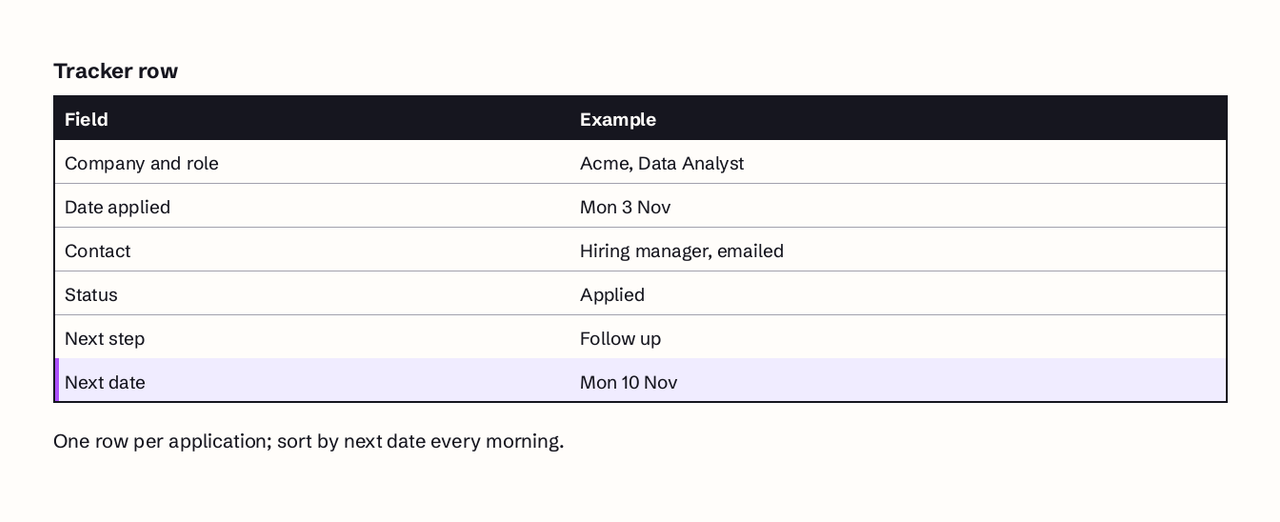
- Set up a tracker with: company, role, link, date applied, contact, status, next step and date.
- Block fixed weekly hours for searching, applying and outreach.
- Set a weekly target you can keep, for example 5 tailored applications and 5 outreach emails, rather than 50 untailored ones.
A career coach explains the company-forward approach: instead of only searching job boards, list 10 to 20 companies you want to work for, track them in a spreadsheet, follow their news and connect with people who work there before a role opens.
Stage 2: What do you check before sending each application?
Check fit, legitimacy and tailoring for every job, before you click apply. This takes 20 to 30 minutes per application and is where most of the results come from.
- Read the posting for must-haves. Paste it into the free job description analyzer to separate must-haves from nice-to-haves and spot red flags.
- Check it is real. The FTC is blunt: "Honest employers, including the federal government, will never ask you to pay to get a job" (FTC job scams guide). Walk away from upfront fees, equipment you pay for and checks you are asked to deposit and forward. Our guide on how to tell if a job posting is fake has a 2-minute check.
- Check the pay range. In California, employers with 15 or more employees must put the pay scale in the posting, and any employer must give it to an applicant on request (California Labor Code 432.3). Colorado, New York and Washington have similar rules.
- Tailor the resume. Compare it against the posting with the free resume job match checker and add the evidence it finds missing, using only things you actually did.
- Check the file parses. Run it through the ATS resume checker for formatting that applicant tracking systems misread.
- Write a short cover letter when the form asks for one: about 150 words, one requirement matched to one result.
- Find a person. Ashby's 2026 benchmarks show referred candidates pass the screen 52% of the time, against 35% overall (Ashby Talent Trends Report). Ask a contact for a referral, or email the hiring manager with one proof point.
- Log it in the tracker with a follow-up date one week out.
Stage 3: What should you track after an interview?
After each interview, record what happened, send a thank-you within 24 hours and set the next follow-up date. This is the stage people most often let slip.
Before the interview
- Research the company: product, customers, recent news, and the interviewer's background.
- Generate likely questions from the job post with the free interview question generator.
- Prepare 5 or 6 stories with numbers in the STAR format; the STAR answer builder flags stories missing a result.
- Prepare 3 questions for them about priorities, team and how success is measured.
After the interview
- Write down within the hour: who you met, what they asked, what worried them, and the stated timeline.
- Send a short thank-you note within 24 hours. The free interview follow-up email generator drafts one by stage.
- Update the tracker: stage, date and next follow-up.
- If the timeline passes with no word, follow up once by email, then again a week later.
Keep timing in perspective. Ashby's median from first to final interview is 14.4 days for business roles and 17.9 days for technical roles, and the median time to fill a mid-level role is 63 days. On the other side, its median time to reject a candidate who was never interviewed is 6 days, so silence after two weeks on a plain application usually means move on, not wait.
Stage 4: What should you check before accepting an offer?
Get the offer in writing, compare it on total value, negotiate once with reasons, and only then resign.
- Ask for the written offer: base, bonus, equity, start date, title, location, benefits start date.
- Compare offers on total compensation, not base alone. Our guide on how to evaluate a job offer has a scoring sheet.
- Negotiate once with reasons tied to scope or market data, not personal needs.
- Check any non-compete, repayment clause or probation period before you sign.
- Confirm background check and reference timing.
- Resign only after the signed offer and any contingencies are cleared.
- Withdraw politely from your other open processes and thank your references.
Which free tools cover the most of this checklist?
You can run the whole checklist with a spreadsheet and the free resources above. The table shows which ones cover which stage.
| Resource | Stage | Cost | Best for |
|---|---|---|---|
| O*NET OnLine | Set up | Free | Job titles, tasks and skills wording |
| BLS Occupational Outlook Handbook | Set up | Free | Pay and outlook by occupation |
| CareerOneStop | Set up | Free | Local salaries and guides |
| Google Alerts | Set up | Free | Tracking target companies |
| FTC job scams guide | Each application | Free | Spotting fake postings |
| Resume job match checker | Each application | Free | Tailoring to one posting |
| Interview question generator | Interviews | Free | Likely questions from the post |
| Spreadsheet tracker | All stages | Free | Follow-up dates |
The part no checklist does for you is volume with quality: tailoring and reaching a real person for every role takes time. JobFinder AI applies to matched jobs on supported employer forms and emails a verified hiring manager from your own inbox, with follow-ups, so stage 2 keeps moving on busy weeks. You can start a hunt here.
Communities and reading worth your time
- Ask a Manager: long-running advice column on applications, interviews and offers, with practical scripts.
- USAJOBS: the official site for US federal jobs, with saved searches and a resume builder that follows the two-page rule.
- ReportFraud.ftc.gov: where to report a job scam in the US.
FAQ
What should be on a job search checklist?
Four stages: setting up (target roles, target companies, resume, LinkedIn, tracker), checking each application (fit, scam check, pay range, tailoring, a contact), interviews (research, questions, stories, thank-you note within 24 hours) and offers (written offer, total compensation, one negotiation, then resign).
What should I do before I start applying?
Pick 1 or 2 target titles, check what they involve and pay, list 10 to 20 target companies, update one master resume and your LinkedIn headline, choose references and set up a tracker with follow-up dates. This usually takes about a week and makes every later application faster.
What do I check before sending each application?
Confirm you meet the must-haves, make sure the posting is real and asks for no money, check the pay range, tailor your resume to the posting using only true evidence, check it parses in an ATS, find a person to contact, and log the application with a follow-up date.
What should I track after an interview?
Track who you met, what they asked, any concerns they raised, the timeline they gave, the date you sent a thank-you note and your next follow-up date. Notes written within an hour of the interview are the most useful for later rounds.
What are the best free tools for a job search?
O*NET OnLine and the BLS Occupational Outlook Handbook for researching roles, CareerOneStop for local salaries, Google Alerts for target companies, the FTC job scams guide for checking postings, a spreadsheet tracker, and free resume match, ATS check and interview question tools for each application.
How many applications should I send per week?
Send as many as you can tailor well. Five well-matched applications with a hiring manager email each are a better use of a week than fifty untailored ones: Ashby's data shows referred candidates pass the screen 52% of the time against 35% overall.