What Else Can I Add to My Resume? A 7-Step Section Audit
Not sure what else to add to your resume? Run a 7-step audit against one job posting to find the skills, projects, certifications and extras that earn their space.
TL;DR: Add a section only when the job you are applying for asks for what it proves. The usual candidates are a skills section, certifications and licenses, projects, volunteer work, languages, awards, publications or relevant coursework. Run the 7-step audit below against one real job posting and you will know exactly which ones belong on your page and which ones to leave off.
If you are asking what else you can add to your resume, the answer depends on the job, not on a generic list. Beyond contact details, a summary, experience and education, you can add skills, certifications and licenses, projects, volunteer experience, languages, awards, publications, professional memberships, relevant coursework and a short "additional information" line. Harvard's career office puts the rule plainly: tailor the resume to the type of position you want, so it reflects the skills that employer values (Harvard Mignone Center for Career Success). So the useful question is not "what can I add?" but "what does this posting ask for that my resume does not prove yet?" The audit below answers that.
What do you need before you start?
You need three things, and the job posting matters most.
- One real job posting you plan to apply to. A target role in general is too vague; you need the actual list of requirements.
- Your current resume, even if it feels thin.
- A raw inventory of everything you have done in the last five to seven years: jobs, side projects, courses, certificates, volunteer roles, tools you use, languages you speak, anything you were recognized for.
Budget about 15 minutes for the inventory and 30 minutes for the audit itself; it saves hours of guessing later. Most people who think they have "nothing else to add" have forgotten a certificate, a project or a volunteer role that directly matches a requirement.
How to find what else to add: the 7-step audit
Follow these steps in order. Each one takes a single action.
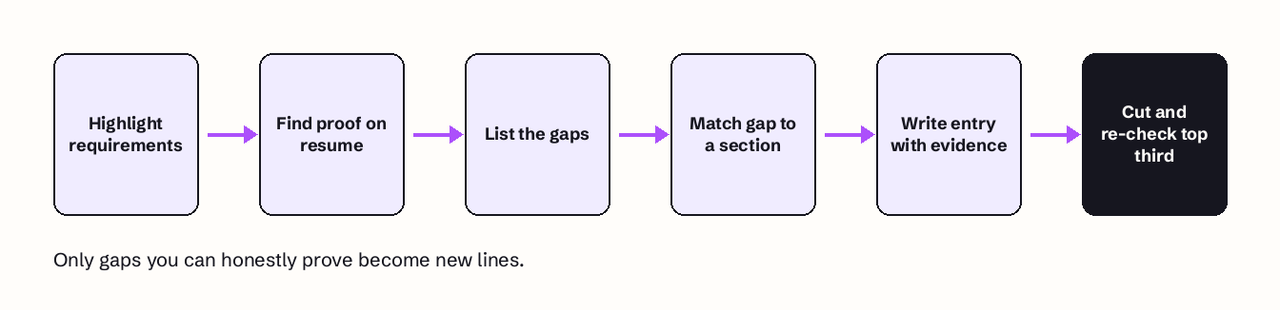
- Highlight every requirement in the posting. Mark each hard skill, tool, credential, language, years-of-experience line and soft skill. Number them. A typical posting has 10 to 20; spend about 5 minutes on this.
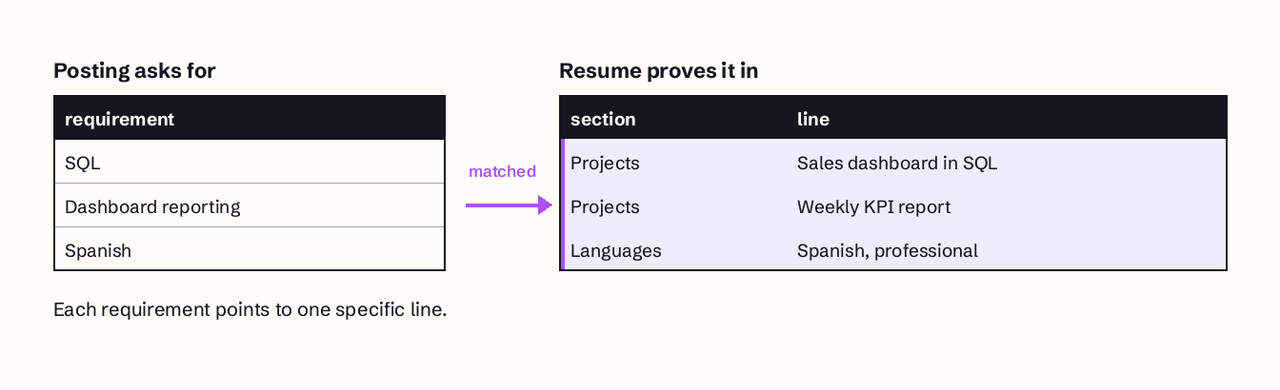
- Mark where your resume proves each one. Next to every requirement, write the line of your resume that proves it, or "none".
- List the gaps. Every "none" is a candidate for something to add. Ignore requirements you genuinely do not meet; this audit is about proof you already have but have not shown.
- Match each gap to a section. A missing tool usually belongs in skills or a project; a missing credential goes in certifications; missing leadership evidence often lives in volunteer work. Use the table in the next section.
- Write the entry with evidence. One line per item, with a date, an issuer or organization, and an outcome where you have one. "Python" alone is weak, and so is "Excel" with no context; "Python: built a pricing scraper that saved a 4-person sales team about 3 hours per week" proves it.
- Cut to fit. Every new line must push something weaker off the page. Remove what the posting does not care about (see "What should you remove?" below).
- Re-check the top third. Read only the top third of the page. If the two or three requirements the posting repeats most are not visible there, move the strongest new evidence into your summary or the first bullets.
How do you verify the audit worked?
Count again, which takes about 5 minutes. Every requirement you meet should now point to a specific line on your resume. If one still points to "none" but you do have the experience, it is still missing.
Which optional sections can you add, and when do they earn their space?
Each optional section has to do a job. Here is what each one proves and the minimum it must contain.
| Section | Add it when | It must contain |
|---|---|---|
| Skills | The posting lists tools or hard skills | Specific named tools and skills, grouped, matching the posting's wording |
| Certifications and licenses | The posting names a credential or a regulated field | Credential name, issuer, date earned or expiry |
| Projects | You lack paid experience in the target skill | Project name, what you built, tools used, a result or user |
| Volunteer experience | It shows a required skill or fills a gap | Role, organization, dates, 1 to 2 achievement bullets |
| Languages | The role serves customers or markets in that language | Language and honest level (native, fluent, professional, basic) |
| Awards and honors | The award is competitive or relevant | Award name, giver, year, how selective it was if known |
| Publications and talks | Research, content, technical or academic roles | Title, outlet or event, year |
| Relevant coursework | You are a student or recent graduate with little experience | 3 to 6 course names that map to requirements |
| Professional memberships | The field values them, like nursing, engineering or HR | Organization name, member since, any role held |
| Additional information | A short fact the reader needs and no section fits | One or two lines: work authorization, relocation, availability, a short gap explanation |
What can I add to a resume with little experience?
With little experience, add sections that prove ability rather than tenure: projects, relevant coursework, volunteer work, certifications, and skills tied to evidence. Students and career changers should put the strongest of these above work history when the work history is unrelated to the target role.
What works best, in order of how much weight a reader usually gives it:
- Projects. A project is work experience you assigned yourself. Name it, say what it does, list the tools, and give a concrete result: users, time saved, a grade, a deployment. "Built a budgeting app in React; 120 classmates used it in the first 30 days" is a full entry.
- Internships, freelance and part-time work. Paid work of any length counts. A 90-day freelance contract with a clear deliverable beats a vague long one. Even 10 hours per week of freelance work for 12 weeks (about 120 hours) is real experience.
- Certifications. Choose ones the posting names or that employers in the field recognize. A certificate that took 2 hours rarely helps; one that took 40 hours of coursework and an exam usually does.
- Relevant coursework. List three to six courses, not your whole transcript. If your GPA is strong, our guide on whether to put your GPA on a resume covers the cutoffs.
- Leadership in clubs, sports or community groups. Treat these like jobs, with achievement bullets.
Harvard also advises avoiding information gaps such as a missing summer (Harvard MCS). If you studied, cared for family, traveled or worked informally, a one-line entry is better than silence.
Should I add volunteer work?
Yes, add volunteer work when it shows a skill the job asks for, when it fills a gap in your timeline, or when it is in the same field. Format it exactly like a job: role, organization, dates, and one or two bullets with outcomes. "Coordinated 12 volunteers for a monthly food drive serving about 200 families per month" says leadership and logistics. "Volunteered at food bank" says nothing.
Put it under Experience when it is directly relevant or substantial, and under a separate Volunteer Experience heading otherwise. Leave it off when it is unrelated and you already fill the page with stronger evidence. Our full guide to volunteer experience on a resume has placement examples by career stage.
One caution: volunteer work for a religious or political organization can reveal something you might not want to share. That is your call. In the US, the EEOC makes it illegal for employers to discriminate based on religion, among other protected characteristics, but you are never required to disclose them. You can describe the work and the skill neutrally.
What goes in the additional information section?
The additional information section holds short, relevant facts that have no natural home elsewhere. Keep it to one to four lines, and only include what helps this application. Good uses:
- Work authorization or visa status, when the posting or country makes it relevant: "Authorized to work in the UK, no sponsorship required."
- Relocation or availability: "Relocating to Austin in March; available to start within 14 days of an offer."
- A short gap or short-stint explanation: "Career break January to June 2023 for family caregiving; available full-time."
- Languages or tools if you have only one or two and a full section would look thin.
- Licenses like a driving license, when the job involves driving.
Former Google recruiter Farah Sharghi makes the case for explaining these on the page instead of hoping nobody notices: a recruiter screening a large pile will not investigate a gap or a three-month job, they will assume the worst. A single line of context removes the doubt.
A former Google recruiter explains why unexplained gaps, short stints and pivots read as risk to someone screening many resumes, and shows how a one-line reason in the experience section or summary removes that doubt.
What does not belong here: hobbies with no link to the job, "references available upon request", or a list of personality traits. Harvard's guide says not to list references at all (Harvard MCS).
Should you add hobbies and interests?
Add hobbies only when they prove something the job values or give an interviewer a genuine hook. Competitive chess for an analyst role, running a cooking channel for a content role, or rebuilding motorcycles for a mechanical engineering role all earn a line. "Reading, travel, music" does not. Once you have enough experience to fill the page, interests are usually the first thing to cut.
What should you remove from your resume?
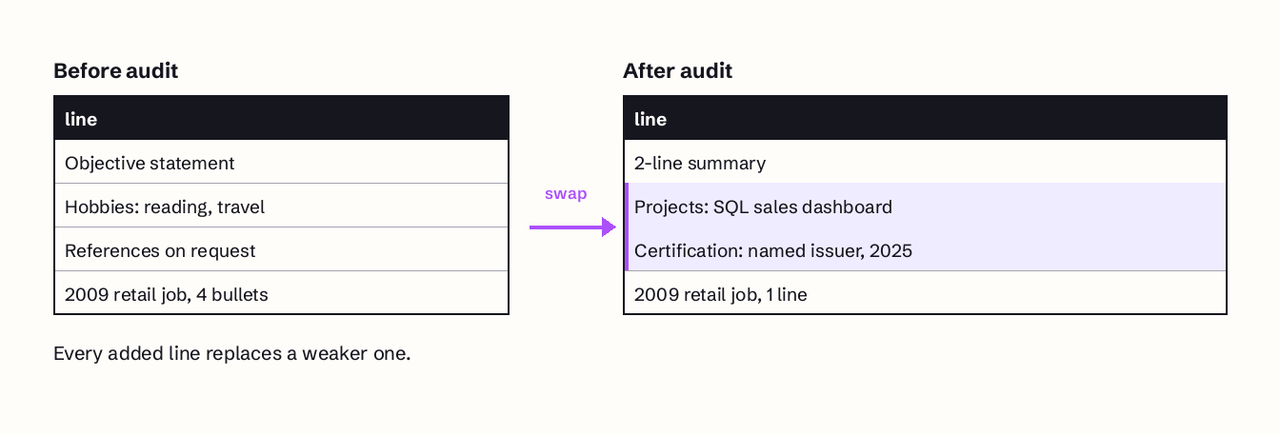
Remove anything the target job does not care about and anything that invites bias or wastes space. Adding is only half the audit; every new line has to displace a weaker one.
Cut these first:
- Personal details: photo, date of birth, age, gender, marital status. Harvard's guide lists picture, age and gender as things not to include, and US employers cannot legally use age (40 or older) and other protected characteristics in decisions (EEOC). Norms differ by country, so check local practice if you apply abroad.
- References and "references available upon request". Employers ask when they need them.
- An objective statement that says what you want instead of what you offer. Replace it with a two-line summary.
- Old or unrelated jobs in full. Highlight the last 5 to 7 years, roughly 70% of the page; compress older roles to two or three relevant bullets, or a single line.
- Duty bullets with no outcome. "Responsible for social media" becomes "Grew Instagram followers from 2,000 to 9,500 (375%) in 8 months, posting 4 times per week."
- Generic soft-skill lists. "Hardworking, team player" proves nothing. Show those qualities in bullets. Our list of words to describe yourself on a resume shows which ones read as evidence.
If your resume is now longer than it should be, see how long a resume should be for page-length rules by experience level.
Where should new sections go on the page?
List headings in order of importance to the reader, and within each heading list items in reverse chronological order, most recent first. That is Harvard's rule, and it holds for most fields (Harvard MCS).
In practice:
- Experienced professionals: Summary, Experience, Skills, then Certifications, Education and any extras.
- Students and recent graduates: Education, Projects or Relevant Experience, Skills, then Activities or Volunteer work.
- Career changers: Summary, a skills or projects section that maps to the new field, then Experience.
- Licensed professions like nursing, teaching or accounting: put Licenses and Certifications near the top, because the license is often a hard screen.
Applicant tracking systems read standard headings most reliably, so name sections plainly: "Certifications", not "My Journey". Our resume keyword scanner pulls the important terms out of a posting so you can check that your new sections use the same words.
Common mistakes when adding sections
These are the errors that make an added section hurt rather than help.
- Unverifiable claims. Every line is an interview question. If you cannot explain a certification or a project in detail, leave it off. Inventing them has real consequences; see whether it is illegal to lie on a resume.
- Keyword lists with no evidence. A skills block of 40 tools invites the question "which of these have you actually used?" Keep the list to what you can back up and use the posting's own wording.
- Junior verbs. Bullets that start "helped with" or "worked on" undersell ownership. Start with what you did: led, built, launched, cut. "Helped with reporting" becomes "Cut weekly reporting from 6 hours to 2 hours by automating the export."
Once you have run the audit once, the slow part is repeating it for every role. JobFinder AI matches your resume against live job postings and tailors each application to that posting's requirements, so the projects, skills and certifications that fit each job are the ones that show up first.
FAQ
What else can I add to my resume besides work experience?
Skills, certifications and licenses, projects, volunteer experience, languages, awards, publications, relevant coursework, professional memberships, and a short additional information line. Add only the ones a specific job posting asks for and that you can back with evidence such as a date, an issuer or an outcome.
What can I put on my resume if I have no experience?
Lead with education, then projects, internships, freelance or part-time work, volunteer roles, certifications and relevant coursework. Write each one like a job with achievement bullets. A project with tools and a concrete result proves ability better than a long list of soft skills.
Is it okay to add certifications that are still in progress?
Yes, if you are actively working on them and they match the job. Write the credential name, the issuer and "expected" with a month and year, ideally within the next 90 days. Do not list a course you started and abandoned, because interviewers will ask about it.
Should I include a photo or my date of birth?
In the US, UK and Canada, no. Harvard's career office advises against including a picture, age or gender, and US employers may not legally discriminate on age or other protected characteristics. Some countries expect a photo, so check local norms before applying abroad.
How many optional sections should a resume have?
Usually one to three beyond the core sections, and each new section should take no more than 10% of the page. Each one must prove a requirement in the posting. If a section has only one weak item, merge it into another section or an additional information line instead.
Where do I put a career break on my resume?
Put a one-line entry in your experience timeline or the additional information section, with dates and a neutral reason such as caregiving, study, relocation or a layoff. Say that you are available now. A short explanation removes the doubt an unexplained gap creates.