Contract to Hire Meaning: How It Works, Pay and Benefits
Contract to hire means a temporary trial period, usually on a staffing agency's payroll, before a possible permanent offer. How it works, what it pays and what to ask.
TL;DR: Contract to hire means you start as a temporary worker for a set period, usually 3 to 12 months and usually on a staffing agency's payroll, and the company decides at the end whether to hire you as a permanent employee. The hourly rate often looks higher than the salary it might become, but unpaid holidays and missing health coverage can close that gap. Price the offer as a year, not an hour.
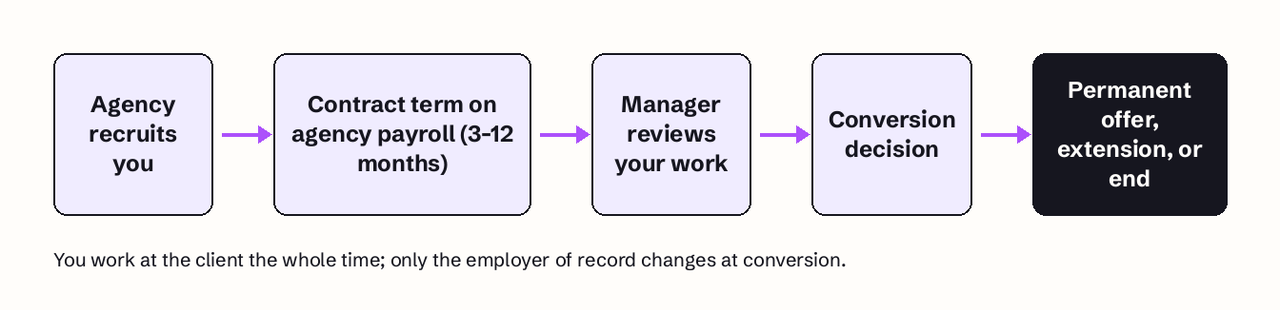
Contract to hire is a hiring arrangement in which you work for a company as a contractor for a fixed trial period, with the stated possibility of being converted to a full-time, permanent employee when it ends. During the contract you are typically employed and paid by a staffing agency (a W-2 employee of the agency, not of the client company), and you usually get fewer benefits than the client's own staff. At the end, the company can offer you a permanent job, extend the contract, or let it end. Nothing in a contract-to-hire offer guarantees conversion, so the honest way to read the phrase is "a temporary job with a trial clause", and the honest way to evaluate it is to compare what you earn and give up during the contract with what the permanent offer would be worth.
What does contract to hire mean?
Contract to hire means the employer wants to see you do the job before committing to a permanent hire. It sits between two other arrangements: a straight contract (temporary, with no expectation of a permanent role) and direct hire (permanent from day one).
The typical setup has three parties:
- The client company, where you do the work, report to a manager and sit with the team.
- The staffing agency, which recruited you, runs payroll, withholds taxes and offers whatever benefits its own plan includes.
- You, paid hourly by the agency, usually for a stated term such as six months.
The agency bills the client a higher hourly rate than it pays you, and that margin is how it earns its fee. If the client hires you permanently, many staffing agreements require a conversion fee or a minimum number of billed hours first. That clause is why some conversions happen exactly at the end of the term and not earlier.
Why companies use contract to hire
Companies use contract to hire when they want to reduce the risk of a bad permanent hire, when budget for a permanent headcount is not yet approved, or when they need someone now and expect the need to last. A manager can often open a contract requisition faster than a permanent one, because contractor spend may come from a different budget line.
For you, that cuts both ways. A role created because "headcount is not approved yet" depends on that approval arriving. A role created to test fit converts when you perform. The questions further down are designed to tell those two apart before you sign.
Is contract to hire W-2 or 1099?
Most contract-to-hire roles placed through a staffing agency are W-2: the agency is your employer of record and withholds income tax, Social Security and Medicare. Some companies hire contractors directly on a 1099 instead, which makes you self-employed for tax purposes.
The difference matters for your take-home pay. The IRS decides worker status on the degree of control and independence, grouped into behavioral control, financial control and the relationship of the parties, and either side can ask for a formal ruling with Form SS-8 (IRS). If you are paid on a 1099, you pay self-employment tax of 15.3% (12.4% Social Security and 2.9% Medicare) on your net earnings, in place of the 7.65% a W-2 employee has withheld; you can deduct the employer-equivalent half (IRS). For 2026 the Social Security part applies to the first $184,500 of combined earnings.
A 1099 contract-to-hire role that has set hours, a manager directing your daily work and company equipment looks a lot like employment. If the work is controlled like a job, ask why it is not paid like one.
Do contract-to-hire employees get benefits?
Contract-to-hire workers usually get the staffing agency's benefits, not the client company's, and those are often thinner: limited or no paid holidays, little or no paid time off, and a health plan you may have to pay for in full. Federal data shows how big the gap is. In the Bureau of Labor Statistics' July 2023 survey, only 16.6% of temporary help agency workers had employer-provided health insurance, against 54.4% of workers in traditional arrangements (BLS).
What you are missing has a price. In KFF's 2026 Employer Health Benefits Survey, the average premium for single coverage was $9,804 a year, of which the average worker paid $1,672 and the employer paid the rest, about $8,132 (KFF). If the contract comes with no employer-paid plan, that $8,132 is part of what the hourly rate has to cover.
Two rules matter at conversion:
- Waiting periods restart. When you become the client's employee, its health plan can make you wait, but federal rules cap any waiting period at 90 days after you become eligible (29 CFR 2590.715-2708). Ask whether your contract months count toward eligibility.
- Losing coverage opens a window. If the contract ends and you lose agency coverage, you have 60 days to enroll in a Marketplace plan through a Special Enrollment Period (HealthCare.gov). Our guide to how long insurance lasts after leaving a job covers COBRA and the timing.
Worked example: is $55 an hour better than a $105,000 salary?
The way to judge a contract-to-hire offer is to annualize the hourly rate, subtract the hours you will not be paid for, and subtract the benefits you will have to buy. Here is one offer worked through.
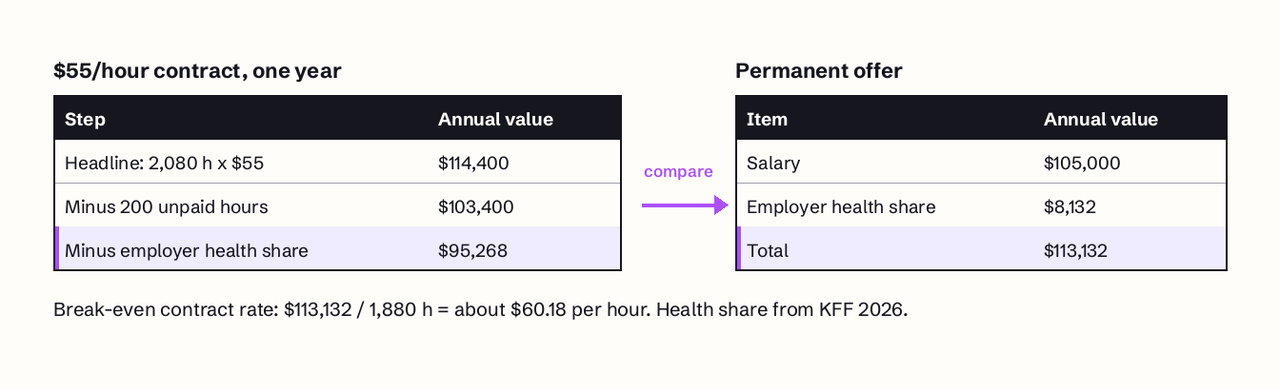
The offer: $55 an hour, W-2 through an agency, 40 hours a week, six-month term. No paid holidays, no paid time off, no employer-paid health plan. The recruiter says permanent staff in the role earn around $105,000 with full benefits.
Step 1: the headline number. $55 x 2,080 hours (40 hours x 52 weeks) = $114,400. This is the figure that makes contract rates look generous.
Step 2: unpaid time. A permanent employee is paid for holidays and vacation. Assume 10 public holidays and 15 days off you would take anyway: 25 days x 8 hours = 200 unpaid hours. 1,880 paid hours x $55 = $103,400.
Step 3: health insurance. Without an employer plan you pay the employer's share yourself. Using the KFF average, that is about $8,132. $103,400 - $8,132 = $95,268.
Step 4: compare. On these assumptions the $55 contract is worth about $95,300 a year in salary-equivalent terms, roughly $9,700 less than the $105,000 permanent role, even though its headline annual figure was $9,400 more.
Step 5: the break-even rate. To match $105,000 plus employer-paid health ($113,132) over 1,880 paid hours, you need about $60.18 an hour. That is the number to take into the negotiation.
Two things can move the result. If you are non-exempt, hours over 40 in a workweek must be paid at no less than 1.5 times your regular rate under the Fair Labor Standards Act (DOL), so a $55 contractor working 45 hours earns $82.50 for each of the extra five. And if the same $55 is paid on a 1099, the self-employment tax works out to about $6,700 more than W-2 withholding on $103,400 (15.3% on 92.35% of net earnings, against 7.65% withheld), before the deduction for half of it. Retirement matching, bonuses and equity, if the permanent role has them, widen the gap further. Our guide to comparing employee benefits in a job offer shows how to price those.
Contract to hire vs direct hire vs contract
Contract to hire differs from direct hire in who employs you and how much is guaranteed, and from a plain contract in what is expected at the end.
| Criterion | Contract to hire | Direct hire | Contract (temporary) |
|---|---|---|---|
| Employer of record | Usually a staffing agency, then the client | The company, from day one | Agency or you (1099) |
| Expected end | Conversion decision after a set term | No end date | Ends with the project or term |
| Typical pay form | Hourly | Salary or hourly | Hourly or per project |
| Benefits | Agency plan, often limited | Company plan | Agency plan or none |
| Paid holidays and PTO | Often none during contract | Usually yes | Often none |
| Security | Low until converted | Highest | Low by design |
| Best for | Getting in the door, testing a team | Stability and full benefits | Flexibility, short projects |
The practical difference from direct hire is risk. Direct hire puts the risk of a bad match on the employer. Contract to hire shares it with you: if the company changes its plans, the contract simply ends.
How often do contract-to-hire jobs convert to full time?
No neutral public data tracks contract-to-hire conversion rates, so treat any single percentage with care. The figure most often quoted comes from the American Staffing Association's 2014 survey of about 12,000 current and former staffing employees: among those whose main goal was a permanent job, 99% said they reached it (ASA survey via PR Newswire). That is an industry body's self-reported survey, and it counts a permanent job anywhere, not conversion at the client.
The federal data shows how many people are in the situation. BLS counted 945,000 temporary help agency workers and 862,000 contract firm workers in July 2023, and 44.8% of contingent workers said they would prefer a permanent job (BLS). Your own odds depend on the company far more than on averages, which is why the questions below matter.
What should I ask before accepting a contract-to-hire offer?
Ask questions that reveal whether the conversion is planned, funded and defined. Ask the recruiter about mechanics and the hiring manager about the role; our guide to the recruiter vs hiring manager explains who owns what.
- How many contract-to-hire people on this team converted in the last year? A manager who has converted people can name them.
- Is permanent headcount for this role already approved? "Pending budget" means conversion depends on something outside your performance.
- What has to be true at month six for you to convert me? Ask for two or three concrete outcomes and write them down.
- What is the conversion salary range, and is it set now? Agree the range before you start, while you still have leverage.
- Is there a conversion fee or minimum-hours clause? It explains the timing and whether early conversion is realistic.
- Am I W-2 or 1099, and what benefits start on day one? Get health, paid holidays and overtime treatment in writing.
- Do my contract months count toward benefits eligibility and tenure? This affects the 90-day health waiting period and vesting.
If the answers are vague, price the role as a plain contract. If you accept, keep your search running: the contract can end with two weeks' notice, and the best leverage at conversion time is another offer. For the counter itself, see how to negotiate salary after a job offer.
Contract to hire pros and cons
Contract to hire has real advantages:
- Faster entry. It can get you into a company, industry or seniority level that would not hire you directly.
- A two-way trial. You see the team, the manager and the actual work before committing.
- Overtime pay if you are non-exempt and hourly.
- A stronger negotiating position at conversion, because the company has already seen your work.
And real costs:
- No guarantee. Conversion can stall on budget, a reorganization or a hiring freeze.
- Thinner benefits and usually unpaid holidays and time off.
- Two employers to manage, with the agency in the middle of pay and contract questions.
- Possible tax cost if the role is 1099.
Common mistakes with contract-to-hire offers
- Comparing hourly x 2,080 to a salary. It overstates the contract by the value of unpaid days and benefits, as the worked example shows.
- Leaving the conversion salary undefined. After six months you have less leverage than on day one.
- Stopping the job search. A plain contract ends, and a quiet pipeline turns that into a gap.
- Ignoring the agency's role. The agency negotiates your rate and holds the conversion clause; read both.
Keeping a search warm during a contract takes time you will not have. Jobfinder AI ranks open roles against your CV, fills supported application forms and, once you approve the first batch, emails a verified hiring contact from your own inbox, so the pipeline keeps moving while you work. For a structured way to weigh any offer you get, use our job offer evaluation guide.
FAQ
What does contract to hire mean on a job posting?
It means the role starts as a temporary contract, usually through a staffing agency, with the possibility of becoming a permanent position after a set period such as three, six or twelve months. Conversion depends on your performance and the company's needs and is not guaranteed.
Is contract to hire a good idea?
It is a good idea when the company has approved permanent headcount, can show recent conversions, and the hourly rate covers unpaid time and benefits. It is a weak deal when conversion depends on budget that does not exist yet and the rate is below the break-even figure for the salary you would accept.
Do contract-to-hire employees get benefits?
Usually they get the staffing agency's benefits rather than the client company's. These are often limited, with few or no paid holidays and a health plan you may pay for yourself. BLS data from July 2023 shows only 16.6% of temporary help agency workers had employer-provided health insurance.
Is contract to hire W-2 or 1099?
Most agency contract-to-hire roles are W-2, with the agency as your employer of record. Direct contracts can be 1099, which means you pay the full 15.3% self-employment tax. Ask before you sign and get it in writing.
Can I negotiate a contract-to-hire offer?
Yes. Negotiate the hourly rate using your break-even number, and agree the conversion salary range, benefits start date and conversion timeline before you start. The agency usually has room between the rate it bills the client and the rate it pays you.
What happens if a contract-to-hire job does not convert?
The contract ends or is extended. You stop being paid when the assignment ends, and if you lose agency health coverage you have 60 days to pick a Marketplace plan. Keeping your search active during the contract is the best protection.