Generic Resume Objective Statements: 10 Rewritten Examples
Ten generic resume objective statements rewritten into targeted ones, a test for when an objective helps, and when to use a summary instead.
TL;DR: A generic resume objective statement says what you want ("seeking a challenging position") and nothing an employer can use. Keep an objective only if you are entry level, changing fields or handing a resume out at a career fair, and then rewrite it to name the role, two skills and what you bring. Everyone else should replace it with a short summary of qualifications.
Generic resume objective statements are one or two sentences at the top of a resume that state a career goal without naming the job, the employer or any proof. The classic version is "Seeking a challenging position in a growth-oriented company where I can use my skills." It fails because it could sit on any resume for any job. Virginia Tech's career office describes a useful objective as one that discusses the skills that qualify you, uses keywords from the job description and focuses on your value to the employer (Virginia Tech Career Quick Start). So the fix is not a better generic sentence. It is a specific one: the role, the field, one or two strengths and a timeframe when it matters. Below are 10 common generic objectives, each rewritten, with a test for when an objective helps and when a summary is the better choice.
Should a resume have an objective at all?
Most resumes should not have one, but three groups still benefit. Virginia Tech recommends an objective when you are new to the workforce, when you are changing industries, and when you are handing your resume out at a career fair, where it "quickly tells the employer if your desires match their needs." It calls the objective optional when you apply to a specific job, because applying already shows your goal fits the position.
The University of Central Arkansas career office is blunter: the traditional objective statement "has become outdated because it takes up space without offering anything valuable," while a summary is geared toward the employer's needs (UCA Career Services). Both views agree on the rule that matters. Whatever sits at the top of your resume has to tell the reader what you offer for this job, not what you hope to get.
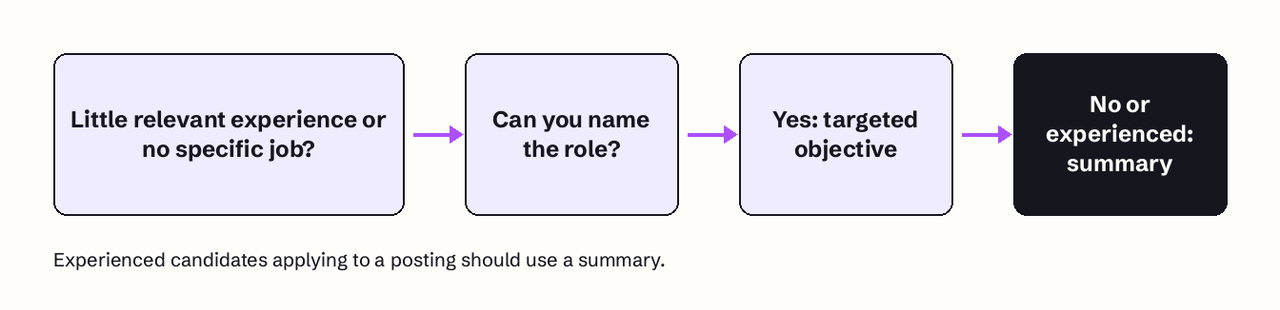
Use this three-question test before you keep an objective:
- Are you a student, recent graduate or career changer with little directly relevant experience?
- Will the resume be read without a specific job attached (career fair, networking, a general talent pool)?
- Can you name the exact role or field you want in a few words?
If you answered yes to question 3 and to either 1 or 2, a targeted objective earns its space. Otherwise, write a summary.
What makes an objective generic?
An objective is generic when you could swap it onto anyone else's resume without changing a word. Four markers give it away:
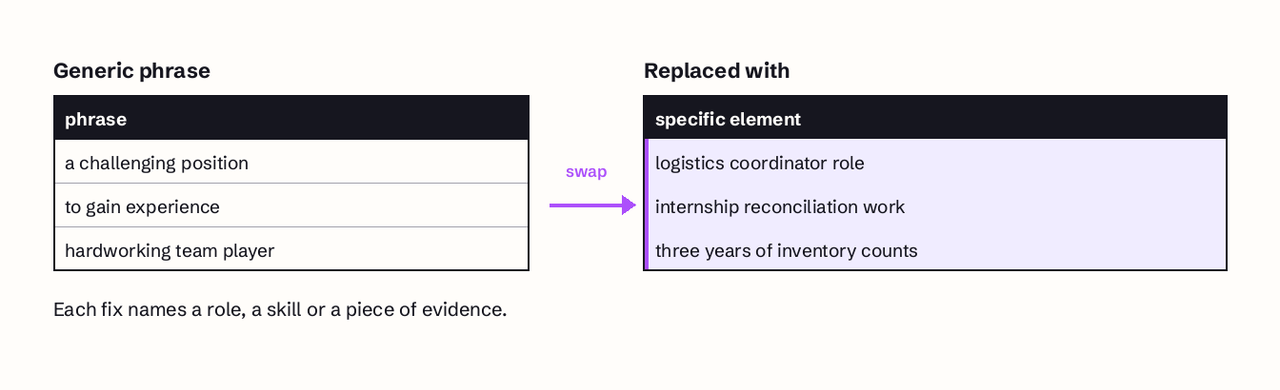
- No role named. "A position" or "an opportunity" instead of "a junior data analyst role."
- Self-focused goals. "Where I can grow" or "advance my career" says what you want from the employer.
- Empty adjectives. "Hardworking, motivated, detail-oriented" with no skill attached.
- Company clichés. "Growth-oriented," "dynamic," "reputable organization."
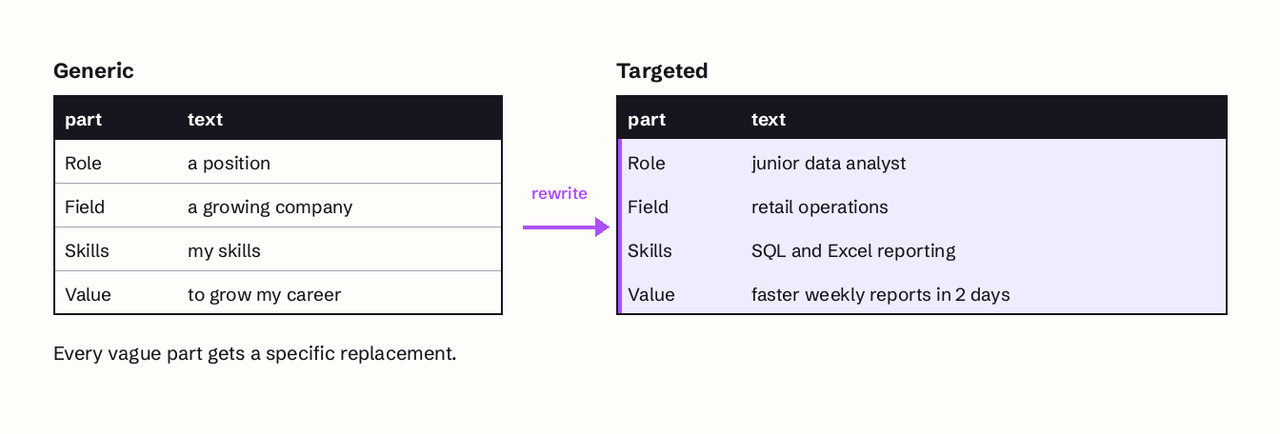
A targeted objective swaps each of those for something specific. Virginia Tech suggests including one or two strong adjectives tied to a skill, a timeframe (summer or fall of a given year), the job type (full-time, part-time, co-op, internship) and the industry area, and keeping it short. That gives you a simple formula:
[Who you are] + seeking [job type and role] + in [field or company] + using [one or two specific skills] + to [what you will deliver].
10 generic resume objective examples, rewritten
Each example below shows the generic version people copy, why it fails, a targeted rewrite and how to adapt it. Replace the bracketed details with your own; never claim a skill you cannot discuss in an interview.
1. The all-purpose objective
Generic: "Seeking a challenging position in a growth-oriented company where I can utilize my skills and experience."
Why it fails: No role, no field, no skill. It is the textbook generic objective.
Targeted: "Operations coordinator with two years of scheduling and vendor management experience (about inbound shipments at 40 per week), seeking a full-time logistics coordinator role at a regional distribution company."
Adapt it: Name the exact job title from the posting and one hard skill it lists twice.
2. The "career growth" objective
Generic: "Motivated professional looking for an opportunity to grow and advance my career."
Why it fails: It describes what the employer gives you, not what you give the employer.
Targeted: "Customer support specialist seeking a team lead role in a SaaS support team, bringing experience training new agents and maintaining a 120-article help-center knowledge base while answering tickets at 50 per day."
Adapt it: Swap "grow" for the specific responsibility you want to take on and the evidence you can already do part of it.
3. The entry-level objective
Generic: "Recent graduate seeking an entry-level position to gain experience."
Why it fails: "Gain experience" is your goal. The reader needs to know what you can already do.
Targeted: "Accounting graduate seeking a full-time staff accountant position, applying coursework in financial reporting and a 12-week internship reconciling vendor accounts, 30 per month."
Adapt it: Spend 5 minutes on this: use your degree, the job title and the most relevant course, internship or project.
4. The internship objective
Generic: "Student seeking an internship to learn more about the industry."
Why it fails: It names no industry and no skill.
Targeted: Virginia Tech's own example is a good model: "Seeking a multimedia journalism internship utilizing photo/video production and web design skills."
Adapt it: Add the term (summer, fall, or dates such as 06/2027 to 08/2027) and the field. Two named skills are enough.
5. The career-changer objective
Generic: "Looking to transition into a new field where I can apply my transferable skills."
Why it fails: It never says which field or which skills transfer, which is exactly what a reader doubts.
Targeted: "Former high school teacher moving into instructional design, seeking an entry-level instructional designer role that uses five years of curriculum development, including 36-week course plans for students, 120 per year."
Adapt it: Name the old role, the new role and the one skill that bridges them. Our guide to words to describe yourself on a resume helps you pick terms that read as evidence rather than adjectives.
6. The "hardworking team player" objective
Generic: "Hardworking, reliable team player seeking a position where I can contribute to the company's success."
Why it fails: Three adjectives and no proof. Any applicant can write it.
Targeted: "Retail associate with three years of front-line sales and weekly inventory counts across 2,000 SKUs, 4 days per month, seeking a part-time assistant store manager role in a specialty retail store."
Adapt it: Spend 2 minutes replacing each adjective with the duty that proves it.
7. The career fair objective
Generic: "Seeking employment opportunities in business."
Why it fails: "Business" covers hundreds of roles, so the recruiter at the booth cannot route you.
Targeted: "Finance student seeking a summer analyst internship in corporate finance or financial planning, with Excel modeling and budgeting coursework."
Adapt it: At a fair, one specific field and one backup is fine. Virginia Tech notes this is exactly where an objective helps.
8. The returning-to-work objective
Generic: "Seeking to re-enter the workforce in a position that matches my experience."
Why it fails: It hints at a gap without saying what you bring back.
Targeted: "Medical office administrator returning to full-time work, seeking a front-desk coordinator role and bringing four years of scheduling patients at 60 per day and verifying insurance within 24 hours of each booking."
Adapt it: State the role, then the most recent relevant experience. Explain the gap briefly in your cover letter, not in the objective.
9. The "any role" objective
Generic: "Open to any role where I can make a positive impact."
Why it fails: Flexibility reads as a lack of direction, and applicant tracking systems have no keyword to match.
Targeted: "Junior web developer seeking a remote front-end role, building responsive interfaces in JavaScript and React and shipping 3 portfolio apps with 90% Lighthouse accessibility scores."
Adapt it: Pick one role per resume. If you apply to two kinds of jobs, keep two versions.
10. The over-long objective
Generic: A five-line paragraph listing every goal, value and hobby.
Why it fails: It buries the one line a reader needs and pushes your experience down the page.
Targeted: Cut it to one sentence using the formula above. If you still need more space to show qualifications, you need a summary, not a longer objective.
Adapt it: Give your top third the 10-second test: read it aloud in 10 seconds or less. If the first sentence does not name the job, rewrite it.
Which one should you use?
| Your situation | Use | Length |
|---|---|---|
| Student or recent graduate | Targeted objective | 1 to 2 sentences |
| Internship or co-op search | Targeted objective with term and field | 1 sentence |
| Career fair or general networking | Targeted objective | 1 sentence |
| Career changer | Objective or a summary that leads with transferable proof | 1 to 2 sentences, or about 50 words |
| Several years in the same field | Summary of qualifications | About 50 words or 3 to 5 sentences |
| Applying to a specific posting, experienced | Summary using the posting's keywords | About 50 words |
Objective vs summary: which should you use?
Use a summary when you have several years of experience in the field you are applying to, and an objective when you do not. Virginia Tech defines the summary of qualifications as an overview of work experience that fits the job's specific requirements, showing you have already done similar work, and suggests keeping it to around 50 words with keywords from the job description. UCA describes a summary as 3 to 5 sentences placed right after your contact information.
The difference is direction. An objective says where you are going; a summary says what you have already done. An experienced candidate who writes an objective wastes the most valuable space on the page. A student who writes a summary often has to pad it with adjectives because there is not yet enough experience to summarize.
Here is the same candidate both ways:
- Objective: "Marketing graduate seeking a full-time content marketing coordinator role, applying SEO coursework and two years of writing for the campus newspaper."
- Summary: "Content marketing coordinator with two years of experience planning and publishing blog and email content for a B2B software company. Manages an editorial calendar, briefs freelance writers and reports on organic traffic monthly."
Both are specific. The second only works once the experience exists.
If you are moving from an objective to a summary, our XYZ resume format guide shows how to turn the experience behind it into bullets with measurable results.
What is a good general objective?
A good general objective is one that is general about the employer but specific about the role and the skill. When you cannot name a company, for example in a resume you hand out at a networking event, you can still name the job type and your strengths: "Bilingual customer service representative seeking a full-time call center or help desk role, with experience handling billing calls at 70 per day in English and Spanish." That works across many employers without becoming generic.
If you truly cannot name the role, the objective is not the problem. Decide what you are applying for first; the resume follows.
How to adapt any objective to a job posting
Harvard's career office advises tailoring the resume to the type of position you want, so it reflects the skills that employer values (Harvard Mignone Center for Career Success). For the objective, that takes about 3 minutes per application:
- Spend 1 minute per posting finding the title, then copy the exact job title from the posting into the objective.
- Find the two skills the posting repeats most and use those words.
- Add the job type (full-time, internship, remote) if the posting specifies one.
- Delete every adjective that is not attached to a skill.
The same check applies to the rest of the page. Our 7-step resume section audit walks through matching every requirement to a line on your resume, and the executive assistant resume keywords guide shows the same keyword matching for one role in detail.
Tailoring each objective by hand takes 3 minutes for one application and an hour for 20 applications at 3 minutes per posting. JobFinder AI matches your resume to live job postings and tailors each application to that posting's requirements, so the role and skills at the top of your resume line up with the job you are applying to.
Common mistakes with resume objectives
- Using the same objective for every job. If the title in your objective does not match the posting, it signals a mass application.
- Naming the wrong company. Copying a tailored objective into the next application without changing the employer name is a common and visible error. Proofread the top line every time.
- Stacking an objective and a summary. Pick one; two introductions push your experience further down.
- Claiming skills you cannot discuss. Every skill named in the first sentence is a likely interview question.
FAQ
Should a resume have an objective?
Only in specific cases. Use a targeted objective if you are a student, recent graduate or career changer, or if your resume will be read without a specific job attached, such as at a career fair. Experienced candidates applying to a posting should use a short summary of qualifications instead.
What is a good general objective for a resume?
A good general objective names the job type and one or two skills even when it does not name an employer, for example "Bilingual customer service representative seeking a full-time call center role, with experience handling billing questions in English and Spanish." It is general about the company, never about the role.
Objective vs summary: which should I use?
Use a summary if you have several years of experience in the target field; keep it around 50 words or 3 to 5 sentences with keywords from the job description. Use an objective if you are entry level or changing fields and need to state your direction, and write it around what you bring.
Are generic resume objectives bad?
Yes. An objective that could appear on anyone's resume, such as "seeking a challenging position to utilize my skills," uses prime space without telling the reader anything. A targeted objective that names the role, the field and specific skills can still help entry-level candidates.
How long should a resume objective be?
One or two sentences. If you need more space to show your qualifications, you have enough experience for a summary instead.
Where does the objective go on a resume?
Directly under your name and contact information, in the top 2 to 3 lines and before education or experience. It is the first thing a reader sees, so it should name the role you are applying for.